If you had to pick a single year that captured popular music at its most creatively overstuffed, 1977 would be a strong candidate. Rock was arena-sized and expensive. Disco was inescapable and, for a certain crowd, irresistible. Punk was arriving like a kicked-in door. And somewhere in between, artists were quietly making records that didn’t fit neatly into any of those categories. The year produced an almost absurd concentration of songs that people still know by heart, not because nostalgia has been kind to them, but because many of them are genuinely excellent pieces of music.
The rock side of ’77 was dominated by songs that have since become impossible to avoid. Eagles’ “Hotel California,” Fleetwood Mac’s “Dreams,” and Bob Seger’s “Night Moves” all came from the same general tradition of polished, emotionally direct rock songwriting, the kind that prioritized feel and production in equal measure. Aerosmith’s “Walk This Way” sat a little rougher and looser, and Manfred Mann’s Earth Band’s “Blinded by the Light” was genuinely strange radio fare — a Springsteen cover that became more famous than the original largely on the strength of its own eccentric energy. Meanwhile, David Bowie’s “Sound and Vision” and Peter Gabriel’s “Solsbury Hill” pointed toward something more interior and experimental, both artists having recently untethered themselves from previous identities and clearly enjoying the freedom.
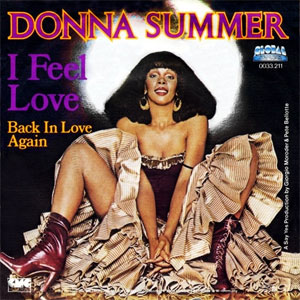
Disco in 1977 wasn’t a single sound so much as a spectrum. At one end, you had Donna Summer’s extraordinary “I Feel Love,” which Giorgio Moroder produced using almost entirely synthesized instrumentation — Brian Eno reportedly told David Bowie it had just changed the future of music, and he wasn’t wrong. Further down the dial were Thelma Houston’s “Don’t Leave Me This Way,” Marvin Gaye’s loose, joyful “Got to Give It Up,” Heatwave’s “Boogie Nights,” and KC and the Sunshine Band’s “I’m Your Boogie Man,” songs that prioritized the floor over the headphones and delivered accordingly. And then there was the Saturday Night Fever soundtrack, which arrived in late 1977 and would go on to become, for a time, the best-selling album ever released. It’s remembered as a disco landmark, but its lead single was the Bee Gees’ “How Deep Is Your Love” — a warm, unhurried ballad which doesn’t really fit the disco label. That the song was swept up into the disco phenomenon anyway says something about how powerful that cultural moment was: it absorbed everything in its vicinity, regardless of what the artists themselves thought they were making.
Punk was having none of it. The Sex Pistols’ “God Save the Queen” was banned by the BBC and still reached the top of the charts, which tells you something about both the song’s impact and the limits of official gatekeeping. Ramones’ “Sheena Is a Punk Rocker” was faster and more fun, but no less pointed. Television’s “Marquee Moon” and Elvis Costello’s “Watching the Detectives” had a punk rock spirit that suggested the genre’s real legacy might not be volume or outrage but a renewed interest in wit and directness — a correction to the perceived excesses of the rock mainstream those same artists were reacting against. These records don’t sound like novelties now. They sound like a genuine argument about what music should be doing.
What’s striking, looking at a year’s worth of this material together, is how little any of these artists seemed to be aware of, or interested in, what the others were doing. “Somebody to Love” by Queen and “Sir Duke” by Stevie Wonder share roughly the same calendar year but almost nothing else. “Solsbury Hill” and “Float On” exist in completely separate universes. That independence — each act pursuing its own idea of what a good record sounded like — might be exactly why so much of this music has held up. Nobody was chasing a trend that would have dated them. They were mostly just making the best version of the thing they already knew how to do, and 1977 happened to catch a lot of them doing it very well.
Follow Tunes Du Jour on Facebook
Follow me on Bluesky
Follow me on Instagram


