Tunes Du Jour Presents 1977

If you had to pick a single year that captured popular music at its most creatively overstuffed, 1977 would be a strong candidate. Rock was arena-sized and expensive. Disco was inescapable and, for a certain crowd, irresistible. Punk was arriving like a kicked-in door. And somewhere in between, artists were quietly making records that didn’t fit neatly into any of those categories. The year produced an almost absurd concentration of songs that people still know by heart, not because nostalgia has been kind to them, but because many of them are genuinely excellent pieces of music.

The rock side of ’77 was dominated by songs that have since become impossible to avoid. Eagles’ “Hotel California,” Fleetwood Mac’s “Dreams,” and Bob Seger’s “Night Moves” all came from the same general tradition of polished, emotionally direct rock songwriting, the kind that prioritized feel and production in equal measure. Aerosmith’s “Walk This Way” sat a little rougher and looser, and Manfred Mann’s Earth Band’s “Blinded by the Light” was genuinely strange radio fare — a Springsteen cover that became more famous than the original largely on the strength of its own eccentric energy. Meanwhile, David Bowie’s “Sound and Vision” and Peter Gabriel’s “Solsbury Hill” pointed toward something more interior and experimental, both artists having recently untethered themselves from previous identities and clearly enjoying the freedom.

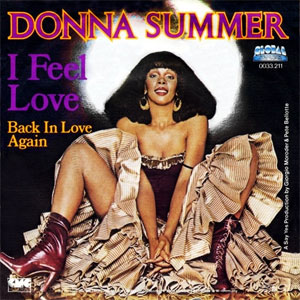
Disco in 1977 wasn’t a single sound so much as a spectrum. At one end, you had Donna Summer’s extraordinary “I Feel Love,” which Giorgio Moroder produced using almost entirely synthesized instrumentation — Brian Eno reportedly told David Bowie it had just changed the future of music, and he wasn’t wrong. Further down the dial were Thelma Houston’s “Don’t Leave Me This Way,” Marvin Gaye’s loose, joyful “Got to Give It Up,” Heatwave’s “Boogie Nights,” and KC and the Sunshine Band’s “I’m Your Boogie Man,” songs that prioritized the floor over the headphones and delivered accordingly. And then there was the Saturday Night Fever soundtrack, which arrived in late 1977 and would go on to become, for a time, the best-selling album ever released. It’s remembered as a disco landmark, but its lead single was the Bee Gees’ “How Deep Is Your Love” — a warm, unhurried ballad which doesn’t really fit the disco label. That the song was swept up into the disco phenomenon anyway says something about how powerful that cultural moment was: it absorbed everything in its vicinity, regardless of what the artists themselves thought they were making.

Punk was having none of it. The Sex Pistols’ “God Save the Queen” was banned by the BBC and still reached the top of the charts, which tells you something about both the song’s impact and the limits of official gatekeeping. Ramones’ “Sheena Is a Punk Rocker” was faster and more fun, but no less pointed. Television’s “Marquee Moon” and Elvis Costello’s “Watching the Detectives” had a punk rock spirit that suggested the genre’s real legacy might not be volume or outrage but a renewed interest in wit and directness — a correction to the perceived excesses of the rock mainstream those same artists were reacting against. These records don’t sound like novelties now. They sound like a genuine argument about what music should be doing.

What’s striking, looking at a year’s worth of this material together, is how little any of these artists seemed to be aware of, or interested in, what the others were doing. “Somebody to Love” by Queen and “Sir Duke” by Stevie Wonder share roughly the same calendar year but almost nothing else. “Solsbury Hill” and “Float On” exist in completely separate universes. That independence — each act pursuing its own idea of what a good record sounded like — might be exactly why so much of this music has held up. Nobody was chasing a trend that would have dated them. They were mostly just making the best version of the thing they already knew how to do, and 1977 happened to catch a lot of them doing it very well.

Follow Tunes Du Jour on Facebook

Follow me on Bluesky

Follow me on Instagram

Your (Almost) Daily Playlist: 10-25-23

Released as a single in 1971, Helen Reddy’s “I Am Woman” tanked. She rerecorded the song. The new version was released as a single the following year, debuting on the Hot 100 at number 99. Two weeks later it was number 97. Then it fell off the chart. Lots of television appearances and many phone calls from Reddy’s husband to radio stations across the US led to the song re-entering the Hot 100, eventually becoming the first of three US number one singles for Reddy and winning her the very first American Music Award for Favorite Pop/Rock Female Vocalist.

The late Helen Reddy was born on this date in 1941. Several of her recordings are included on today’s playlist.

Follow Tunes du Jour on Facebook

Follow Tunes du Jour on Twitter

Follow me on Instagram

Your (Almost) Daily Playlist: 9-1-23

The Bee Gees wrote “How Deep Is Your Love” at the Château d’Hérouville in France, where Chopin had stayed and played piano, though Chopin wasn’t involved in the recording of the song, as he was busy being dead. The song was intended for Yvonne Elliman, but Robert Stigwood, the producer of Saturday Night Fever, said “No, no way. Uh uh. Forget it.” The Gibb brothers took their song to number one, the first of 7034 number one hits (give or take) from the Saturday Night Fever soundtrack. HDIYL spent 17 weeks in the top ten of the Billboard Hot 100, a record at that time.

Bee Gee Barry Gibb was born on this date in 1946. A half dozen of his group’s hits are included on today’s playlist.

Follow Tunes du Jour on Facebook

Follow Tunes du Jour on Twitter

Follow me on Instagram

Your (Almost) Daily Playlist: 8-27-23

The Captain & Tennille’s “Love Will Keep Us Together” was a huge hit in 1975, but not everyone agreed with its message. Ian Curtis, the leader of Joy Division and a newlywed in 1975, was one of them. His composition “Love Will Tear Us Apart” could be seen as a response to the cheerful song, expressing his disillusionment with love and life. He took his own life in 1980, a month before his song was released as a single, on its way to becoming a classic.

Daryl Dragon, better known as The Captain, a nickname given to him by The Beach Boys’ Mike Love, was born on this date in 1942. A few of his duo’s hits are included on today’s playlist.

Follow Tunes du Jour on Facebook

Follow Tunes du Jour on Twitter

Follow me on Instagram

Throwback Thursday – The Hits Of 1977

An instrumental performed by then new Eagles member Don Felder was submitted to his bandmates Glenn Frey and Don Henley to add lyrics. The first working title the guys gave the song was “Mexican Reggae.”

Henley was determined to create the perfect song, spending eight months in the studio working on “Mexican Reggae,” which came to be called “Hotel California.” A lyric referring to the band Steely Dan was added (“They stab it with their steely knives but they just can’t kill the beast”) after Steely Dan included the lyric “Turn up the Eagles, the neighbors are listening” on their song “Everything You Did.”

In 2009, music critic John Soeder asked Don Henley about the lyric “So I called up the Captain / ‘Please bring me my wine’ / He said, ‘We haven’t had that spirit here since 1969’,” pointing out that wine isn’t a spirit, as wine is fermented whereas spirits are distilled. Soeder asked the singer/composer “Do you regret that lyric?” Henley replied “Believe me, I’ve consumed enough alcoholic beverages in my time to know how they are made and what the proper nomenclature is….My only regret would be having to explain it in detail to you, which would defeat the purpose of using literary devices in songwriting and lower the discussion to some silly and irrelevant argument about chemical processes.” Insert steely knife here!

This week for Throwback Thursday, Tunes du Jour listens to the hits of 1977, kicking off with Eagles’ “Hotel California.”


Click here to like Tunes du Jour on Facebook!
Follow me on Twitter: @TunesDuJour

It Never Rains In Southern California

As you may have heard, our sleepy little hamlet of Los Angeles got some rain over the past week. I assume you heard this because Los Angeles is the center of the world and our weather is likely reported everywhere, especially when we get rain, which lesser cities take for granted. More rain is forecast for this week.

If you were near a radio in the United States in 1972, you heard Albert Hammond’s hit single “It Never Rains in Southern California,” and learned that while in L.A. it never rains, it pours. Man, it pours.

Today’s playlist consists of songs with word rain or some variation thereof in the title. It includes Albert Hammond’s “It Never Rains in Southern California,” one of two top forty singles Hammond had as an artist. (The other was 1974’s “I’m a Train.” Remember that one? Didn’t think so.) As a songwriter, Hammond’s hits include The Hollies’ “The Air That I Breathe,” Leo Sayer’s “When I Need You,” Starship’s “Nothing’s Gonna Stop Us Now,” Whitney Houston’s “One Moment in Time,” Chicago’s “I Don’t Wanna Live Without Your Love,” Ace of Base’s “Don’t Turn Around,” Julio Iglesias and Willie Nelson’s “To All the Girls I’ve Loved Before” and The Pipkins’ “Gimme Dat Ding.” His son is a founding member of The Strokes.

Back to the weather. Get your umbrella and enjoy today’s playlist while the sun is still shining.

2014-06-26 16.10.45

“I Have Heard The Future Of Rock And Roll, And It Is The Clash.”

2014-06-26 16.10.45
“I have heard the future of rock and roll, and it is The Clash.” I said that to my friend Laura. The year was 1986. The Clash had already broken up. Sometimes I’m fashionably late to the party.

The Clash released their self-titled debut album in 1977. At that time I was very much a Top 40/Disco kid, listening to KC & the Sunshine Band, The Bee Gees, Eagles, Leo Sayer, ABBA, Stevie Wonder, Barry Manilow and Fleetwood Mac, etc. I’d read about punk rockers in Rolling Stone and Billboard, with their spitting and complaining. No thank you!

I heard a few Clash songs in the few years that followed – their two US top 40 singles “Train in Vain” and “Rock the Casbah,” plus “Should I Stay or Should I Go.” I liked all of those, but assumed they were the exception. They didn’t sound like the way I read punk described.

In 1986 I was working at CBS Records. One of the perks was employees could order five records or tapes each month from the CBS Records catalogue. I got the entire Springsteen back catalogue and some Dylan releases. Eventually I got around to ordering The Clash’s catalogue. I read about them so often and the records were free, so why not?

Wow! London Calling was the most impressive and the one that led to my rave review to Laura. It was not at all what I expected. It was very melodic and very accessible, with a diverse range of styles. The other albums all had their moments, enough such moments that I wouldn’t hesitate to recommend any of their albums.

Let me amend that – I wouldn’t hesitate to recommend any of their albums except Cut the Crap, released after Mick Jones left the band.

While I’m often way ahead of the general population on songs and artists that eventually gather wide acclaim, sometime I’m slow. The Clash was one of those times. And, in retrospect, I suppose I was a tad hyperbolic when I declared Men At Work to be the new Beatles.

Today Mick Jones of The Clash (and later Big Audio Dynamite) turns 59. Here are ten gems.