If you had to pick one song to sum up 2006, you might reach for Gnarls Barkley’s “Crazy” — a song so omnipresent that year it practically became ambient noise. But that choice would also tell you something true about the year: it was a moment when genuinely strange, interesting ideas were landing at the top of the charts, not just surviving on the margins. Cee Lo Green and Danger Mouse made a song that was simultaneously soulful, psychedelic, and completely radio-friendly, and somehow the world went along with it. That tension — between the weird and the accessible, between art and commerce — runs through a lot of what made 2006 a particularly interesting year in music.
The mainstream pop landscape was, by any measure, stacked. Justin Timberlake’s “My Love,” with its spare Timbaland production and T.I. verse, pointed forward toward the minimalist R&B that would define the next decade. Beyoncé released “Irreplaceable,” a song so well-constructed it barely needs any production to hold your attention. Rihanna was still in her early hitmaking mode with “SOS,” and Nelly Furtado, working with Timbaland, was having a pop renaissance with “Promiscuous.” What’s notable in retrospect is how many of these tracks were built around restraint — the arrangements have room in them, the hooks don’t have to fight to be heard. It’s pop music that trusted the song.
On the rock side of things, the year had an interesting split personality. Arctic Monkeys had exploded out of Sheffield with “I Bet You Look Good on the Dancefloor,” all nervous energy and sharp elbows, while The Killers’ “When You Were Young” pushed toward something more cinematic and earnest. The Raconteurs gave Jack White a different context to work in, and “Steady, As She Goes” was proof that a riff-first approach still had plenty of life in it. Muse were somewhere in the atmosphere with “Knights of Cydonia,” a song so committed to its own grandiosity that it looped back around to being genuinely exciting. Meanwhile, Band of Horses released “The Funeral,” which occupied a completely different emotional register — slow, aching, and built to last.
Away from the obvious mainstream, 2006 had a lot happening in the spaces between genres. TV on the Radio were making rock music that felt genuinely new with “Wolf Like Me,” while Hot Chip and Junior Boys were finding the emotional depth available in electronic pop. The Knife’s “Silent Shout” was something else entirely — icy, theatrical, and slightly unsettling in the best way. Camera Obscura offered a gentler alternative with “Lloyd, I’m Ready to be Heartbroken,” a song that wore its Lloyd Cole reference as a badge of honor, and The Pipettes were busy making sharp, witty girl-group pop that felt both nostalgic and pointed. Hip-hop, meanwhile, was getting some of its most creatively ambitious work from Kanye West (“Touch the Sky”) and Lupe Fiasco, whose “Kick, Push” used skateboarding as a fully realized metaphor for outsider identity without ever feeling forced.
There were also moments in 2006 that went beyond music into something more like public conversation. The Chicks released “Not Ready to Make Nice,” a direct response to the backlash they’d faced since 2003, and the fact that it became a hit felt genuinely significant — a mainstream country-adjacent audience giving space to a song about refusing to apologize. Cat Power’s “The Greatest” was quieter but no less affecting, a meditation on loss and missed potential delivered with a stillness that made it hit harder. Morrissey was still being Morrissey (“You Have Killed Me”), which is either a comfort or an irritant depending on your history with the man. What holds all of this together isn’t a single sound or movement — it’s more that 2006 was a year when music across a lot of different genres was being made by people who seemed to be thinking carefully about what they were doing, and the results have held up.
Throughout the next however many months I’ll be counting down my 100 favorite albums, because why not. I’m up to number seventy.
It was May 1985. “We Are the World” was on the radio, New Coke was in the fridge, and America’s favorite dad was Bill Cosby. WHAT WERE WE THINKING?? New Coke?
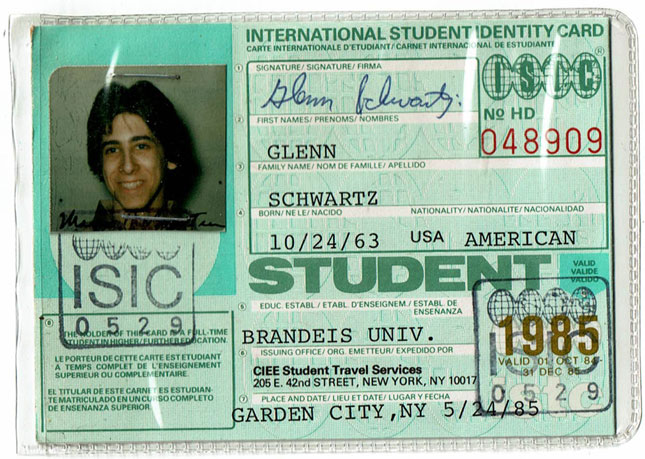
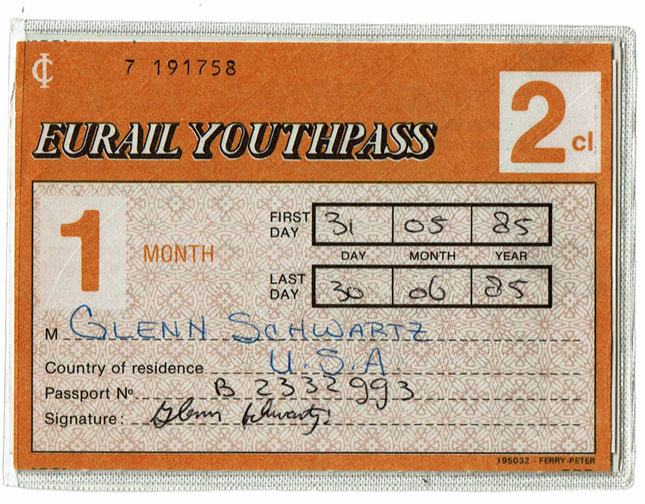
That month, having just graduated college, I, along with six friends—Amy, Autumn, Bruce, Ira, Mike, and Regan— boarded a plane for our self-designed Highlights Of Europe Tour. Six countries! Eight cities! Landmarks! Art! Authentic Cuisine! Exclamation points galore! We had Eurail passes. We had a copy of Europe On $25 A Day. And just like my bar mitzvah turned me from a boy into a man, I was convinced that a month of trains, museums, and whatever authentic cuisine is would turn 21-year-old me into a sophisticated, cultured citizen of the world, one who could talk about my “gallivanting” across “the continent” with the “hoi polloi” and make it sound natural.
***
STATION #1: LONDON
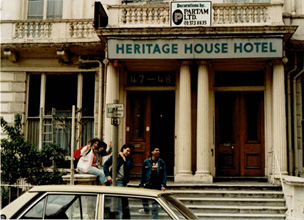
Our hotel in London was the Heritage House, a name that suggests a certain level of grandeur it had no intention of delivering. It was not a Victorian manor with wood-paneled libraries and sprawling lawns, but a Britain of a different heritage, say at the time of the Industrial Revolution, the hotel façade suggesting not glamour but those halcyon days of war and disease. But I didn’t care. I was in London. My only requirements for a hotel room were that it had a door and a bed. The Heritage House exceeded expectations. Not only did my room have a door and a bed but for no additional charge they served us a morning ration of tea and toast. That was enough luxury for me.
The Heritage House Hotel. It looks precisely as cheerful as it felt.
We spent our days dutifully marching from one famous place to another: Big Ben, Windsor Castle, the Tower of London, the London Bridge (btw, not falling down), Trafalgar Square, Hyde Park, Kensington Gardens, and Westminster Abbey. We set foot on the campus of London’s most prestigious, historic, respected and elite university—Cambridge. Or maybe it was Oxford. (I’d make a “tomato/tomato” joke here but it only works if you can hear the typical American pronunciation, then the British pronunciation, so just imagine I said something clever.) We viewed the changing of the guard at Buckingham Palace, a solemn ritual that essentially is like the shift change at 7-Eleven done with more pageantry and furrier hats. We had tea at Harrods. We rode on the top of a double-decker bus. We saw, in its natural habitat, an actual British punk whose long, high, stiff, red and white Mohawk made him look like the angry love child of a cockatoo and a candy cane. I took a photo of Mike pretending to make a call in a red telephone booth. Yes, we did it all. Thankfully, I took lots of photos and saved every admission stub and receipt, for I remember none of it.
We went inside the British Museum, a name that must have been a placeholder suggested at 4:59 PM on a Friday. Despite avoiding museums during my college years in Boston (I’m not sure Boston had any), visiting all the museums while in a foreign city is required of tourists. The taking of photographs was forbidden in the British Museum, so I just did a Google search so I could tell you what I saw, which included Egyptian mummies, ancient Greek bowls, and centuries-old West African sculptures, enabling the visitor to appreciate Britain’s rich history. Per the Google search, the most popular exhibit is the Rosetta Stone. In 1985, I was sure Rosetta Stone played keyboards in Sly & The Family Stone. Today, I know better. It’s the software that teaches you Spanish, named after an old rock I have no recollection of ever viewing.
Outside the National Gallery (are they even trying?), I witnessed a pigeon create a Jackson Pollock-inspired work on the shirt of my friend Bruce. An art critic might have called it a masterpiece of abstract expressionism. Bruce, however, was not a big fan of Pollock’s drip period. Inside, the paintings were a blur of dour-faced aristocrats and gloomy crucifixions. Were aristocrats always so dour? Were crucifixions always so gloomy? Almost everything was exceedingly serious and dark, and for the most part I couldn’t tell one painter’s style from another. A visitor would stare at a da Vinci painting for several minutes, and I’d be reminded of my family’s cat, Dr. Jekyll, who would stare for hours through a window entirely shrouded by a shrub. What are they seeing that I’m not? My arts education—mandatory elementary school trips to museums, where we’d shuffle through the rooms like tiny, corduroy-clad convicts partaking in supervised rec time—had not prepared me for the unexpected day when I would visit a museum voluntarily. Our third grade teacher, Mrs. Halpern, taught us to revere the name “da Vinci,” but not why. I should have asked “What are the prevailing theoretical frameworks for assessing a painting’s aesthetic and artistic merit?,” but instead eight-year old I went with “When’s lunch?” Thirteen years later, I was left to deal with the consequence of that choice—a feeling of inadequacy over my cultural illiteracy. So sad. I’m in my Blue Period.
Some of the National Gallery’s pieces broke through the gloom. I appreciated the works of Monet and Seurat—relaxing vistas, some showing relaxed people relaxing. They were a splash of joy in a Very Serious Building. Van Gogh’s radiant yellow sunflowers were bright and cheery, giving off a “don’t worry, be happy” vibe that can only come from someone who clearly enjoys every moment of their life, and his self-portrait had lots of blue, my favorite color. Paintings could always use more blue. I stared at that Van Gogh self-portrait longer than I did all the crucifixion paintings combined. They would have benefited from a splash of blue. Maybe a radiant Mediterranean blue sky as the backdrop and sunny yellow flowers in the foreground would lighten the mood and make viewers like me want to linger.
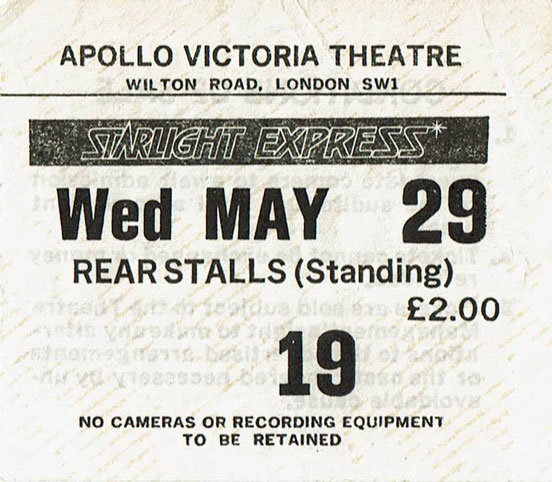
Of course, whilst in London, one must also attend the theatuh. After all, this is the city that brought prominence to William Shakespeare. A ticket stub tells me I saw Sweeney Todd for a mere £2.80, which, cool. Don’t remember a single second. I do remember seeing the musical Starlight Express, as it was literally hell on wheels.
Spandexed actors on roller skates portrayed toy trains. Our hero was Rusty, a steam engine with low self-esteem. The villains were a diesel engine named Greaseball, and an electric engine, named—wait for it—Electra. GET IT?? Electra, ‘cause she’s…oh, you got it. The English sure do suck at naming things.
Speaking of sucking… at one point in the show, a deity known as the Starlight Express—the Jesus of trains—descended to give Rusty a pep talk. This was followed by a rap number from the freight cars that went: “Freight is great / We carry weight / ‘Cause we are freight / And freight is great.” I was witnessing the birth of the expression “like watching a trainwreck.” Autumn said it was a privilege to see the show before its inevitable Broadway triumph. The only triumph I witnessed was my ability to remain awake. This show is lame / I don’t get its fame / I’m not glad I came / Cause this show is lame.
Because we were broke and seeing Europe on $25 a day, we’d bought two-pound standing-room-only tickets, which put us in the back of the auditorium with the other poors. By the time Rusty whined about his love for Pearl the observation car, I was no longer watching the show; I was reading the only material I had on me to read—the show’s Playbill. I saw the tiny, postage-stamp photo of the composer, and then I looked up. I looked back at the photo; then I looked up again. There he was. The actual Andrew Lloyd Webber, thief of my two pounds and two-plus hours, standing two people away from me in the cheap non-seats. Did the man who wrote the music for Cats and Jesus Christ Superstar have no connections who could score him a proper seat? Why was he here? Had he lost a bet? Or was he in the back so he could observe the audience’s honest reactions, far from the sycophancy he was accustomed to? That must be it. Why else would he subject himself to this?
I decided that as soon as the show ended I would go up to him and give him my honest feedback and request an autograph. While thinking of a genial way to say “Your musical has made me question my will to live,” I saw the cast taking their bows. The lights came up, I caught his eye, and poof—the seven-time Tony Award winner was gone. I couldn’t help but feel a little responsible for his running off so quickly, what with my reading during the show and letting out many award-worthy yawns. Did my non-verbal feedback influence his future work? I’d like to think so. I don’t recall any rapping trains in his Broadway production The Phantom of the Opera, the 1988 Tony Award-winner for Best Musical. You’re welcome, Webber.
Before I board an actual train to my next European stop, I must mention the highlight of London: Piccadilly Circus, a hopping part of town with lots of lights and foot traffic. A neighborhood where I lost some pounds, and I don’t mean weight. Ba dum tss. For there, just steps from each other, stood Tower Records, HMV, and a Virgin Megastore. The authors of Europe On $25 A Day didn’t mention record stores, so money spent there didn’t count toward the daily quota. A nice hotel room is a fleeting thing; a rare 12” single lasts forever. I snagged cool releases unavailable stateside from icons such as Sade, Wham!, and Culture Club. Mike was the only of my friends who joined me. The rest convinced themselves there were other things to do in London besides shop for records. Sometimes I wondered why they bothered to fly all that way. You can find photos of the Important Sites in books, but where else could one go, in those pre-Spotify/YouTube days, to discover different mixes of Billy Ocean’s hits?
And so ended my time in London. The official sites were all well and good, but the moments I recall with the most clarity could not have been found in a guidebook. The pigeon Pollacking on Bruce. Sending a world-renowned composer fleeing. Finding a Billy Ocean 45 where on the B-side of his worldwide smash “Caribbean Queen,” he offered “European Queen,” the exact same song with one word swapped. My tweed cap’s off to you, Billy Ocean, you mad genius! The feeling someone else gets from a da Vinci, I get from an Ocean. And you know what? That’s okay. “Different strokes for different folks,”to quote Sly & the Rosetta Stone.
***
STATION #2: AMSTERDAM
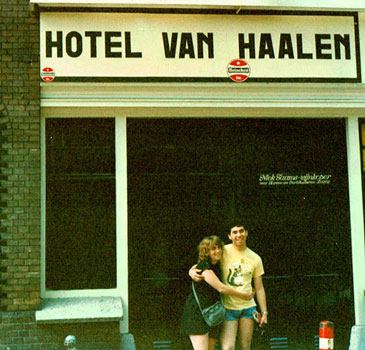
Our lodgings in Amsterdam were at the Hotel Van Haalen—a name that, to our 1985 American ears, had nothing to do with a 17th-century Dutch painter I’d never heard of until earlier this afternoon, and everything to do with guitar solos and high kicks.
We found Hotel Van Haalen after arriving in Amsterdam. Following our guidebook’s sage advice to inspect the merchandise before purchasing, one of our team, Ira, asked the concierge if we could see a room before committing.
Have you ever watched someone ask an innocent question and immediately wished you could blend into the faded tulip wallpaper?
The concierge slammed his fist on the reception desk. “See a room?!” His voice got progressively louder as he questioned our manners, asked if we were raised in barns, ranted about the sickness of our generation, and ended by yelling “It’s the same despicable arrogance that led the Americans to bombard the village of Quallah Battoo in 1832! You’re all the same. Get out of my hotel! You are not welcome here.”
Faced with such a baffling and hostile reception, we did the only sensible thing a group of tired 21 and 22-year-olds could do: we apologized for Ira’s outrageous behavior, explaining this was his first time being more than four hours from Long Island. We apologized for the invasion of Quallah Battoo, whatever that was. We begged the concierge to please take our money for a few rooms. Luckily, he accepted our apology and we checked in. It felt rude not to.
That sorted, we began our tour of Amsterdam’s hallowed cultural sites, navigating the sidewalks with the hyper-vigilance of a bomb-disposal experts, as pooper scooper laws wouldn’t arrive to the city until the late 1990s.
Our first must-see site was the Anne Frank House, in whose attic and secret rooms 13-year-old Frank, her family, and four other people hid from the Nazis. Powerful, sobering, moving—these are some of the words used to describe it. I took it in, thinking, “Wow. This is unforgettable. A profound experience that will stay with me forever.” At least I think that’s what went through my head, as I have since forgotten it. Completely. Every detail of every room has left my brain to make room for Billy Ocean song lyrics. I don’t know if that makes me a “bad Jew,” but if Anne Frank, while going through what she was going through, could write in her diary “I still believe, in spite of everything, that people are truly good at heart,” I’m sure she’d forgive me for no longer being able to picture the room where she wrote that.
Next was the Van Gogh Museum. After loving his yellow flowers and blue self-portrait in London, I was excited to see more of his work.
Turns out Van Gogh painted approximately three dozen self-portraits. Three dozen. The man was obsessed with his own face, though he wasn’t what a modern person would call influencer material. When he wasn’t painting himself, he was painting fruit. Bowls of fruit. Baskets of fruit. Fruit on plates. Fruit on tables. Just so much fruit.
I didn’t get it. Do people actually stare at bowls of fruit for extended periods (if they’re not stoned)? I could appreciate the technical skill, but a still life of pears strewn across a table like it was the cleaning person’s day off didn’t make me feel anything. Not even hungry.
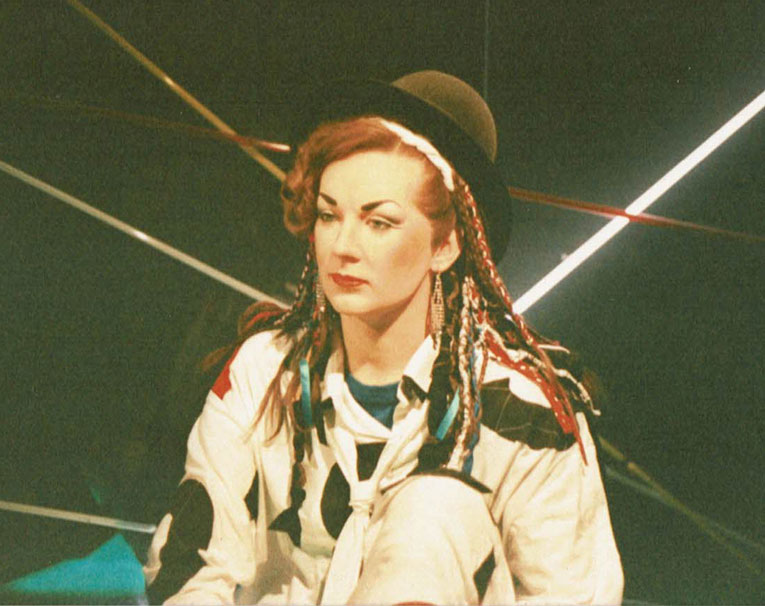
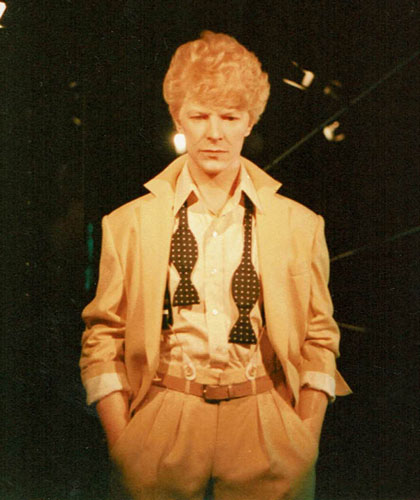
Disappointed, I left the Van Gogh Museum with the hope that at the next stop I’d encounter art that stirs emotions. That’s exactly what happened. Feelings of joy, inspiration, excitement, and wonder rose to the surface like beef ravioli in a pot of boiling water at the next cultural landmark—Madame Tussaud’s Wax Museum. There one could get close to a celebrity without fear they’ll run from you because you didn’t like their shitty new musical. There was no pretense within this collection. Wax David Bowie looked like a wax David Bowie. Wax Michael Jackson looked like a wax Michael Jackson and at the same time looked more human than human Michael Jackson. And wax Boy George, whether intentional or not, perfectly captured the feeling of ennui that comes from looking at multiple paintings of fruit in a bowl. I’m not saying Madame Tussaud was BETTER than Van Gogh, but at the time of this writing there are 26 Madame Tussaud’s Wax Museums in the world and only one Van Gogh Museum.
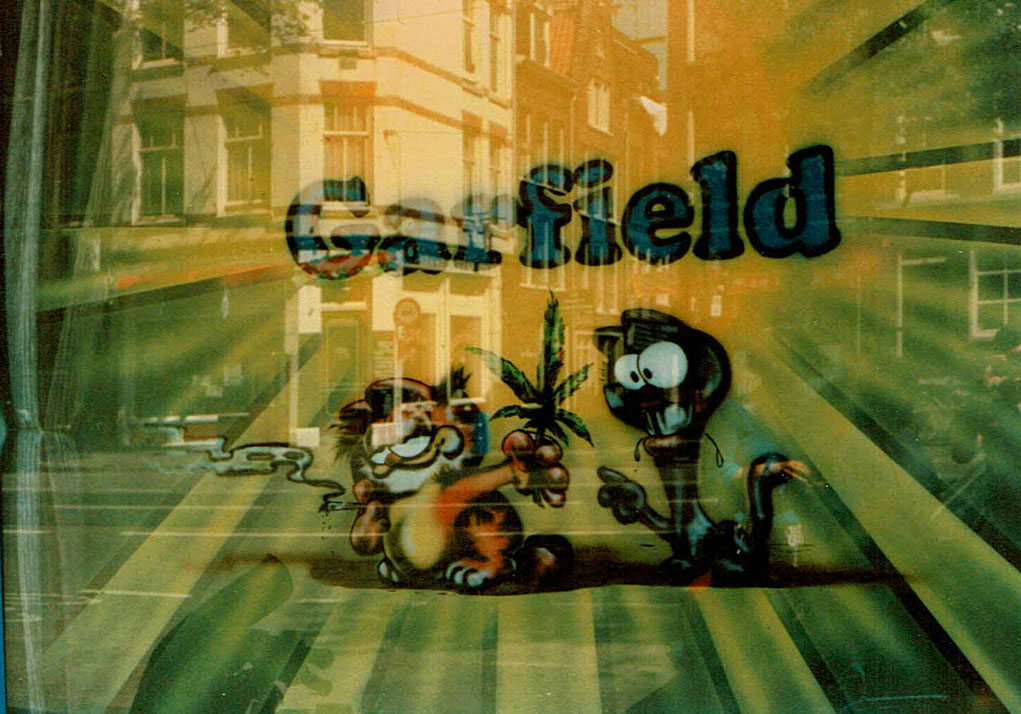
There were two famous Amsterdam attractions I decided to skip. The first was the Red Light District, as I wasn’t in the market for a souvenir that required a follow-up visit to a clinic. The second was the city’s famous “coffee shops.” Back in 1985, I thought coffee shops sold coffee. What a doofus! Cafés sold coffee; coffee shops sold cannabis, and many coffee shops dotted the dogshit-coated sidewalks. While they weren’t exactly legal, there was a tacit agreement with the authorities: the shops could operate as long as they were discreet. No direct advertising and no marketing to minors. That means absolutely no images of marijuana associated with cartoon characters that might appeal to children.
Anyway, here’s a photo I took of a shop window:
Proof that Garfield’s laziness and insatiable appetite had a very specific, botanical origin. Please excuse the reflective glare on the window. On that particular day the sun was, appropriately, blazing.
That wasn’t my first encounter with Aunt Mary. During my teens my parents grew a small crop in the backyard. Despite its ready availability at 16 Carol Drive, I’d never fired up the jazz cabbage. My abstinence stemmed from two things: the fear that if I were high I might shoplift a candy bar or join a cult; and a stubborn, teenage rebellion against my mother, who regarded my sobriety as a personal failing. So when my traveling companions in Amsterdam indulged in the local “space cakes,” which I assumed were brownies laced with angel dust, I refrained. I’m not going to give my mother the satisfaction of my developing a PCP addiction.
One night, we ended up at a club where everyone who wasn’t me was profoundly stoned. The music wasn’t exactly club music, and the patrons weren’t exactly dancing. They were swaying, like sea kelp in a gentle tide. I was the sober Jane Goodall among the zonked-out chimps. These were the people who could stare endlessly at a bowl of fruit and find meaning. Does this mean if I were to partake in the devil’s lettuce, I might experience art differently? Might I be moved by a Van Gogh still life or enjoy a performance of Starlight Express? We’ll never find out. I’d sooner shoplift a Snickers and join a cult.
I never felt that I was missing something profound by remaining sober. Maybe it’s okay to not be like everybody else. Maybe it’s okay to be the guy on the outside looking in. Maybe it’s okay to like what I like. Maybe I should write my own guidebook.
***
STATION #3: MUNICH
Our first stop in Munich (after checking into a hotel without issue) was Marienplatz Square’s Glockenspiel, a large mechanical clock with 32 life-size characters that twice daily re-enact scenes from Munich’s history: its top half tells the story of the 16th century marriage of Duke Someone-or-Other to Whomever; then the bottom half depicts a lively dance by local craftsmen celebrating the end of the 1517 plague. Following this joyous jig of population decimation, a tiny golden rooster at the top of the Glockenspiel flaps its wings and chirps weakly. In 1908, when the clock was constructed, this dude’s wedding and the plague were the two most notable events in Munich’s history. The city would later become the birthplace of the Nazi party, a historical development for which, one notes, they have not yet added a charming, life-sized clockwork reenactment. Apparently, once your town becomes historically interesting in the most horrifying way imaginable, you decide to stick with the quiet rooster.
Walking from the Glockenspiel we passed a store with an alarming name—Christ Schmuck, two words that generally aren’t heard next to each other unless you’re a passenger in my dad’s car. “Christ, schmuck, choose a lane!” he’d yell at other drivers, who couldn’t hear him through the closed windows. As Jews from New York, my friends and I knew a schmuck was a jerk—not as bad as a putz, and a distant relative of the yutz. Say what you will about Jesus; I’ve never heard him called a jerk. Many of his followers, sure, but the man himself? I was let down to find out they didn’t sell sacrilegious knick-knacks, for I was in the market for a crucifix that plays “The Hallelujah Chorus” when you press on Jesus’s tummy. I arrived in Munich knowing two German words: gesundheit and luftballons. And then I learned that “schmuck” is the German word for jewelry. Christ Schmuck sold religious-themed jewelry. Nothing blasphemous about it. Boy, did I feel like a yutz.
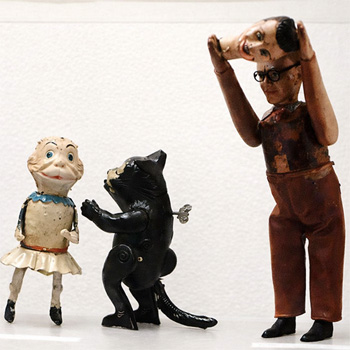
Later, we found the Spielzeugmuseum, a toy museum, which sounds adorable until you step inside and realize it’s less “Barbie’s Dream House” and more an explanation of how a not insignificant part of Germany’s 20th century history came to be. My childhood toys were Tonka trucks and Lincoln Logs, with which I pretended to build things. The toys in the museum were something else entirely. Displayed haphazardly on the shelves were grim-faced soldiers holding tiny bayonets, porcelain dolls that made the twins from The Shining look like Cabbage Patch Kids, a wind-up black cat that looked ready to strangle the frog-face woman in the very short skirt next to him, and most intriguing: an “action figure” of a man in thick, black-framed glasses wearing pants several sizes too large, holding a decapitated head. If you’re an insightful person like me, you’re picturing the only sensible explanation—Jack Benny got dressed in the dark to beat a hasty retreat from yet another orgy gone horribly wrong. If you’re not analytical like me, I’m sorry if I’ve forever killed the arousal you felt when thinking about Jack Benny.
Given the context of this museum, I could understand the decapitated head. But the glasses and comically oversized pants threw me. What was this figurine’s backstory? At the toy factory, did Frederick, the supervisor, yell at his underling, “Günter, I asked you to create an action figure for young boys and this is what you bring me? A hulking man holding a severed head? This is your idea of a children’s toy? Kids need something less brutish. Give him clown pants and glasses. That’ll make him less threatening.”
Whatever their backstory, I was entranced. These were items that raised questions. What becomes of children who play with such disturbing toys? Will they end up in prison? In a psychiatric hospital? Running a major European country? You look at these grim little figures, and suddenly, you understand. You give a kid a tiny soldier holding a bayonet, he’s probably not going to grow up to be a florist. These weren’t merely toys; they were warning signs. What was displayed in this museum was disturbing and unusual, yet captivating and thought-provoking.
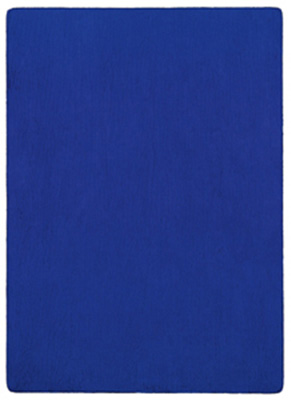
The theme of unusual, captivating and thought-provoking continued at the Staatsgalerie moderner Kunst. I admired the surrealist works of Salvador Dalí—melting clocks, elephants with the legs of Tina Turner, a 1929 painting he titled “The Great Masturbator” (much more skilled than run-of-the-mill masturbators. You know who you are.). Dali seemed like a man who enjoyed a space cake on the daily. But it was a creation by a different artist that blew me away. The artwork was a solid blue rectangle and the artist was Yves Klein. I no longer recall if it was on canvas or paper, but I remember thinking it was perfect. My friend Regan didn’t share my enthusiasm. “Anybody could do that,” she scoffed, to which I replied “The point isn’t whether you could do it. The point is you didn’t. Klein did.” And it checked off all of the boxes on my newly-forming checklist for what constituted great art: it was blue, it made me feel something, and boy, did it raise questions.
The most significant question was a game changer for me: who says art has to be complicated? Who says art needs to look (or sound) like it took a long time to complete? Dolly Parton wrote both “Jolene” and “I Will Always Love You” in a single evening. Are you seriously going to tell me those songs aren’t masterpieces, you pompous piece of shit? (That last question wasn’t directed at Regan or you. That was for the hypothetical philistine questioning Dolly.) Christ, schmuck, don’t make me sic my army of tiny, bayonet-wielding soldiers on you.
I liked the Klein piece because it didn’t tell you what to think. It didn’t say “Here are flowers. Flowers are pretty. Like this painting.” Or “Here is a bearded man sticking his finger in another man’s gaping wound. Life is miserable.” I could project whatever I wanted onto Klein’s canvas. And while not everybody in the museum appreciated the work as I did (as evidenced by the fact that I had an unobstructed view), a curator found it worthy of inclusion, and Klein’s shade of blue has its own Wikipedia entry. I may be in the minority, but I’m not alone.
In 1957 Klein displayed eleven identical blue canvases at a gallery, all for sale, all priced differently. He also composed the Monotone Symphony, a D-major chord sustained for 20 minutes, followed by 20 minutes of silence. In addition, Klein once staged an exhibition called The Void which consisted of an entirely empty gallery. That makes perfect sense to me. You can’t call something The Void and then fill it with stuff. That would be like opening a store called Just Shirts and having it sell smoked salmon.
This blue rectangle—simple, unorthodox, rebellious—showed me what art could be. Not for everyone. Not playing by the rules. Just boldly, defiantly itself. That’s my kind of art.
***
STATION #4: VIENNA
Next came Vienna, known for its boys choir, Wiener Schnitzel, and being the title of a Billy Joel song from 1977. I hadn’t completely given up on Billy Joel by 1985—we were still four years away from “We Didn’t Start the Fire”—though my college friend Kathy forever tainted “Uptown Girl” for me by insisting its drums sounded like Nazis marching.
Which brings us back to Vienna.
Vienna has been called “The City of Music,” which is a grand claim for a city whose only contribution to the pop charts was Falco. The month we set off for Europe, Falco released “Rock Me Amadeus.” The best that can be said about that song is that it doesn’t sound like Nazis marching. The best that can be said about my time in Vienna is that I didn’t see Nazis marching.
We were there for three days, long enough to know that the city has never experienced a day of sunshine ever. We didn’t let the constant rain stop us from heading out each morning to see all we were told the city had to offer.
There’s a palace the locals consider to be famous. We arrived there, wet, to find it was closed for a national holiday or a visiting head of state or maybe it was inventory day. Like most everything about Vienna, my memory is fuzzy. Did we visit churches? Probably. Did we see art? Maybe. I remember the rain. I remember the grayness. I remember the puddles. I remember nothing else.
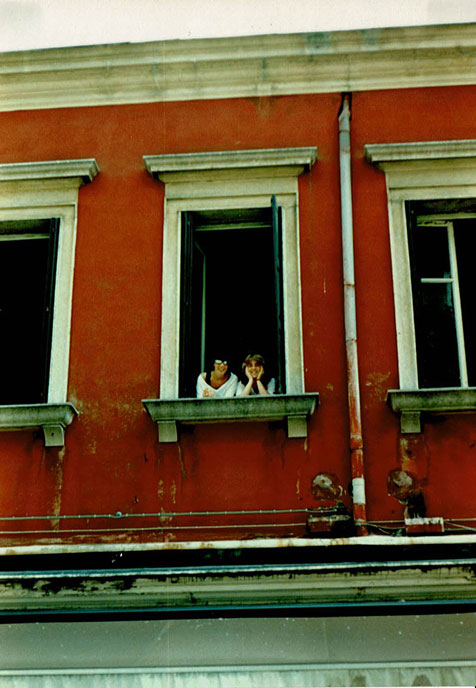
At least our Vienna lodging was top of the line
***
STATION #5: VENICE
You know the Venice spiel: a city on water, a labyrinth of canals, centuries-old splendor, BLAH BLAH BLAH. Those words don’t capture what makes Venice special. Venice is like the “It’s a Small World” ride at Disneyland, but better. In the Disneyland ride you sit in a boat with a dozen other mammals, next to a friend or family member or Christ Schmuck forbid —a ruffian from one of the Dakotas wearing a t-shirt that reads “HERE’S THE BEEF” and has an arrow pointing down—and move along a track, delighting in this around-the-world excursion watching children sing and feeling exhilarated that war, poverty, disease and hunger have been eradicated. In Venice, the boat is a gondola—much nicer—and you share it with two friends where the worst sartorial decision might be Mike’s Duran Duran t-shirt. A gondolier rows you to your destination, and the whole ride you’re Madonna in her “Like A Virgin” video. I felt, if not quite shiny and new, at least—compared to Vienna—less whiny and blue. This was more like it. A city with personality, originality, and that Katrina and the Waves “Walking On Sunshine” weather. Venice was life-affirming.
Then I tried the pizza.
You’d think Italy would have good pizza. I’d been told from an early age that pizza—possibly the greatest food ever created—comes from Italy. The gastronomical crime I ingested in Venice made me question that origin story the way I questioned the existence of God and the legitimacy of the 1876 presidential election. That piz—I can’t even call it pizza. Let’s call it pizzoff. That pizzoff was cheesier than “Rock Me Amadeus” and saltier than a seaman’s slang. The best thing that can be said about it is that it kills bacteria in your mouth and throat, saving you a dental co-pay.
Beyond the traveling by gondola and the nasty-ass pizza, the details of Venice get hazy. I’m sure I saw a museum and stepped inside a church. It’s all a blur.
***
STATION #6: FLORENCE
Florence had a buttload of pigeons. Florence had a fuckton of statues. Pigeons everywhere. Statues everywhere. Pigeons walking in groups, like tourists who just dismounted the bus and didn’t want to lose each other. Statues holding other statues, like fathers cradling their armless bambinos. The buttload of pigeons were not impressed by the fuckton of statues. The pigeons shat freely and frequently all over the statues, and the statues did the same to the pigeons. Everyone’s a critic. But buttloads and fucktons and shit notwithstanding, it’s a beautiful city.
What?
Those statues, though. I didn’t connect with them. For example, look at the dude above. The big cream-colored dude, not the green little person. Let’s start with his couture. A tunic with a belt two inches below his nipples. A hat in one hand, the living room curtains draped over the opposite wrist. He doesn’t appear to be wearing pants, but we’ve all had those days when we’ve gone to the grocery store having forgotten to put on pants, so I’ll let that slide. But no shoes! In a city carpeted with pigeon droppings! That’s so disgusting I literally can’t even. So while the city planner in me appreciated having three thousand statues per square foot, these weren’t the ones I wanted to see. I think there should be a statue of a tourist, camera in one hand and a water bottle in the other, wearing jeans with their tunic and the nipple belt that holds their fanny pack, shvitzing and caught mid-yawn. Engraved in its base would be ALRIGHT ALREADY.
As we were in Florence, the birthplace of the Renaissance, we visited the Uffizi Gallery and the Accademia Gallery. I’m not going to say that da Vinci and Botticelli didn’t know how to paint, but Jesus! Literally! The artwork was all Jesus this and Jesus that and Jesus something else and Jesus Jesus Jesus Jesus Jesus and the Virgin Mary and gods and saints and Jesus. Geez, such original subject matter! It’s like each of them were at school copying off the canvas of the kid next to them. Jesus’s dad forbid they paint something else! Admittedly, I’m an atheist Jew, so maybe I’m not the target audience. In 1985, 21-year-old Glenn worshiped Prince. He was my God. But would I have wanted to view a thousand paintings of Prince? [long thoughtful pause] Actually, yes. But Jesus isn’t Prince. Prince wrote “Raspberry Beret.”
A break in Jesus came in the form of the works of Caravaggio, whose portraits include Boy Bitten by a Lizard, Young Sick Bacchus, Rest on the Flight into Egypt, and Boy Peeling Fruit. He may not be my favorite artist, but the man knew how to title a painting.
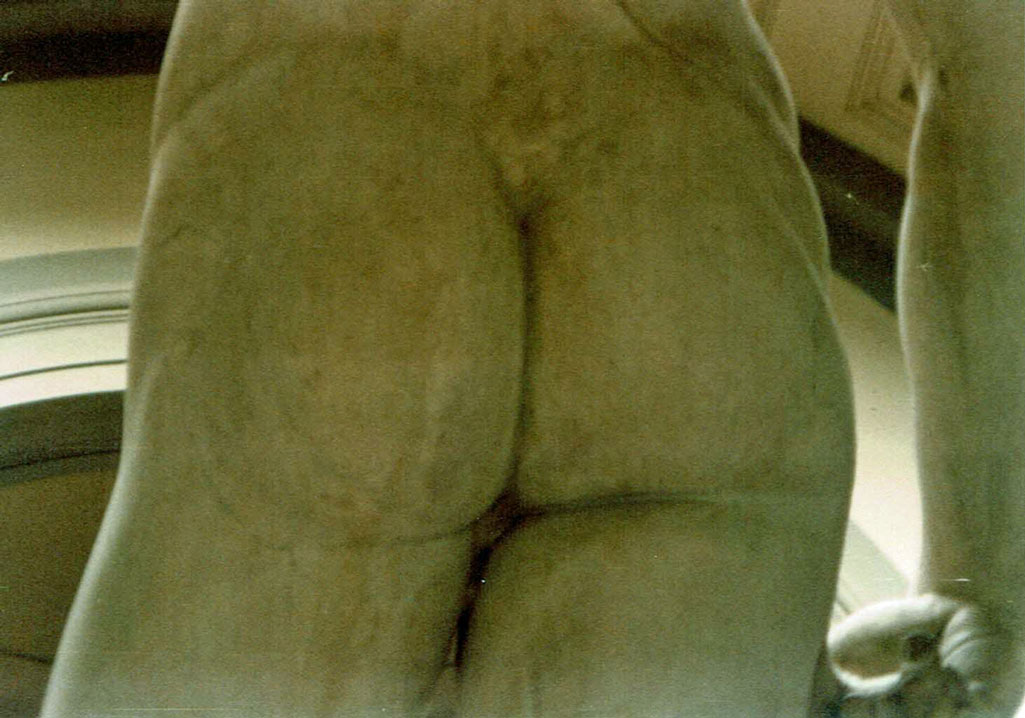
More my speed was the 16th century thirst trap that is Michelangelo’s David. After weeks of trudging through museums, I’d finally learned to recognize art when I saw it, and damn skippy, David was a fine piece of art. Though I was hopelessly heterosexual in 1985, I couldn’t deny that David had a rockin’ bod—exactly the kind of guy I’d want if I were “that way.” Since I didn’t know when I’d be passing through Florence again, I needed to take in all of this aesthetically fine model. Well, almost all. Lest anyone get the wrong idea, I told myself “Don’t look at his Wiener Schnitzel. Don’t look at his Wiener Schnitzel. Get your kicks above the waistline, Sunshine. Don’t look at his Wiener Schnitzel.”
I looked at his Wiener Schnitzel. Eh. He’d never be a centerfold in Inches magazine, a publication I stumbled across every time I went to the newsstand looking for Billboard.
As much as David filled my mind with new thoughts (about sculpture), all of this art was taking a toll on me and my friends. We were culturally bloated. This trip was starting to feel like a series of compulsory marches through Important Old Places, awesome as they were. We needed a vacation from our vacation. The sight of David’s perfectly sculpted glutes had sent a subliminal message to our worn-out souls. We needed a beach.
Look at that perfect art!
***
DETOUR: PISA, NICE
The plan was to escape to Nice for some beach time, but Italy was like, “PSYCH!” Somewhere en route to the French Riviera, the entire Italian rail system went on strike. We were dumped in Pisa. From the train window we saw its second most famous site, the leaning tower. Of course, its most famous site is…just kidding. The only thing there is the leaning tower. An architect makes a huge mistake and suddenly a city is on the map.
Did I want to climb it? Hell no. I’m terrified of heights. More importantly: NO MORE SITES. NO MORE CULTURE. My brain couldn’t take anymore. I JUST WANTED TO LAY ON A BEACH. Lean, straighten up, fall down—I didn’t care.
After renting a car to complete the journey, we finally collapsed in Nice. For two days, we did nothing. No museums. No churches. No palaces. No woman, no cry. We’d reached the point in our grand tour where the most profound cultural experience we could handle was a nap.
***
STATION #7: PARIS
And then, Paris.
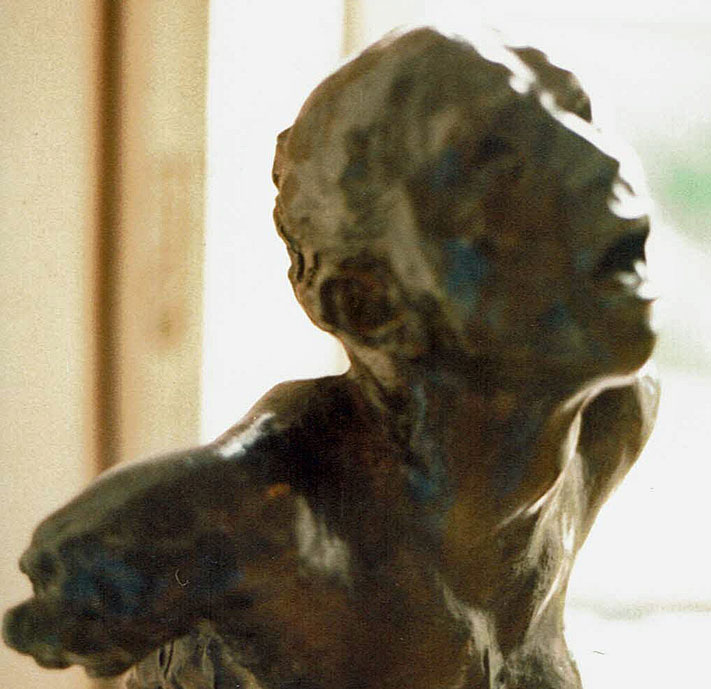
We began at the Rodin Museum, admiring the sculptor’s greatest hits: The Thinker and The Kiss, though my personal favorite, with which I was previously unfamiliar, was The Cry. Rodin intended this bust of a middle age man to display perseverance despite pain, grief and despair, but to me it looked like a boy getting the Heimlich maneuver. His chest was thrust forward, eyes bugged out, mouth open, ready to barf out a mushy cube of regurgitated brioche. Either way, the message was the same as what Corey Hart, the “Sunglasses At Night” guy, commanded us to do on his then new single—“Never Surrender.”
Next stop—Notre Dame, a cathedral best known for its progressive hiring of a man with an excessive curvature of the spine. To reach his tower, one had to traverse a walkway roughly the width of a ruler with only a knee-high wall keeping one from teetering off the ledge and splatting on the sidewalk 300 feet below like a mushy cube of regurgitated brioche. It’s safe if you’re a rat, but not if you’re a 5’10” acrophobe like moi. It’s been said that facing your fears is the surest way to conquer them. On the other hand, it’s also the surest way to death or disfigurement. Just ask the Venus di Milo. To get over her fear of sharks, she went swimming with them, and next thing you know, she couldn’t volunteer to clap the erasers after class.
Then the voice in my head made its presence known. “Glenn, bubelah, you’re in PARIS. This is NOTRE DAME. You HAVE to go to the bell tower. Don’t be a chicken. Buck-buck-buck-buck.” Though I don’t much care for that guy, internal Glenn was right. I’d come this far. It’d be ridiculous to stop now. What would Corey Hart say? Never surrender! Sweat formed on my forehead and in my pits. My heart raced. I took a deep breath. I flattened myself against the ancient wall like a terrified human starfish, fixed my gaze straight ahead, and with a series of sideways teeny tiny steps s l o w l y made my way. Finally I reached the bell tower. In it I saw a bell. I’m not sure what I was expecting to see, but I felt like a prize asshole.
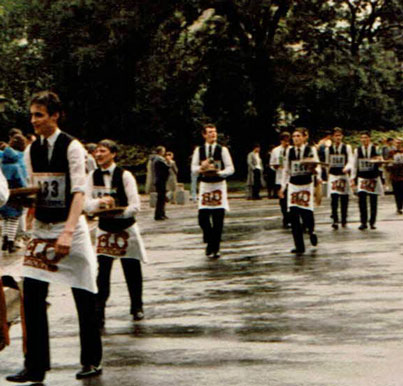
As we were leaving the cathedral a squadron of waiters in crisp white shirts sprint past while holding trays of food and drinks miraculously level. I was dying to know wtf was happening, but the only French I knew came from songs:
Voulez-vous coucher avec moi ce soir?
Les yeux sans visage
Ça plane pour moi, moi, moi, moi, moi
None of these phrases would be of service when inquiring about what appeared to be a city-wide catering emergency. I had been forewarned about the infamous French attitude aimed at those who don’t speak the language, so I dare not ask anyone in English what I was witnessing. If the Olympics Committee were smart, they’d add whatever this was to the summer games to increase viewership. I’d watch, and I think my neighbor Mitchell would, too.
The original Door Dash
We saw the Arc de Triomphe, one of the nicer Arcs I’d seen. We spent hours at The Louvre, where I saw the shark-bitten Venus De Milo, the Mona Lisa (which the museum called La Jaconde to confuse tourists—the French HATE the English language), Whistler’s Mother, a sphinx, a mummy, and other cool shit that would be out of place if displayed in my family’s living room, but suited the vibe the Louvre was aiming for: the drawing rooms of a fantastically wealthy hoarder. Sculptures that pre-dated Christ by over 2000 years, paintings from the 1500s, a dead person from around 300 BC, give or take—all are welcome.
It would be folly of me to leave the Mona Lisa as a passing reference, for Leonardo da Vinci’s masterpiece may be the most famous painting in the history of the world. It was alright, I suppose, though if you’ve seen a photo of the painting, you’ve seen the painting. The only difference is that in person, she’s behind glass and it’s difficult to get up close as throngs of tourists crowd her, all desperate for a glimpse of the piece of art they’ve been told their entire lives they must see. She’s treated like a bat in an enclosure at the zoo, or a lady on display in the Red Light District I avoided in Amsterdam. I knew that it was of the utmost importance that I take a picture of Mona to have at the ready should any person I encounter in the rest of my natural born days need evidence of my viewing the most famous painting in the world; however, after failing to get a decent photo through the glare of the glass enclosure and the sea of heads, I gave up and bought the postcard in the gift shop.
Then, after leaving The Louvre and wandering with no particular aim, I turned a corner and there it was. The Eiffel Tower. In the flesh, or whatever the expression is for something that doesn’t have flesh. Photographs diminish it. Keychains trivialize it. It is truly awesome. Standing before it was a “WOW!” moment. I thought “I really am in Europe,” as if the last four weeks may as well have been the Jersey shore. The tower is high. Very high. I thought back to the day before, at Notre Dame, and how I pushed through my fear of heights to muster up the courage to go up into the bell tower. Welp, you’re not going to trick me this time. Fool me once, shame on you. Fool me twice, your grandma’s a whore. I took a photo from ground level, then on to the next stop.
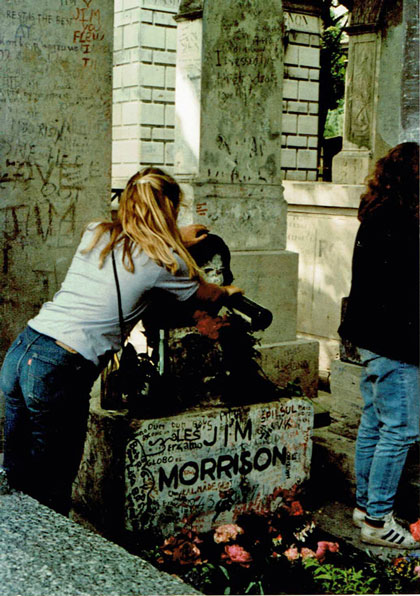
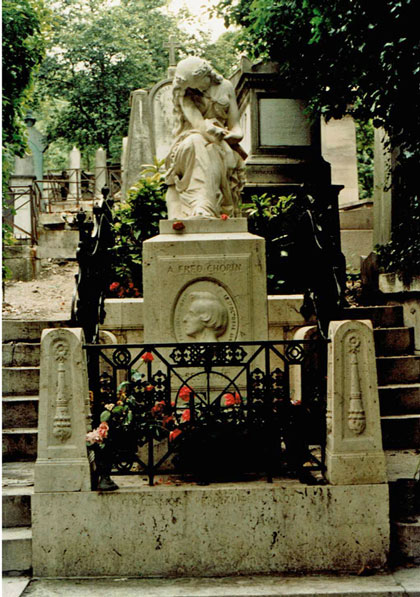
My friends and I trekked to the grave of Jim Morrison of the rock and roll outfit The Doors, on whose gravestone sat a bunch of young hooligans who looked like they wandered over from an Amsterdam disco, wasted on space cakes and not displaying proper burial ground decorum. (See the photo below of a girl offering the deceased rock star a swig of her hooch. People are strange.) In the same cemetery was Chopin’s grave, which was quieter. I worried his ghost looked over at Morrison’s and thought, “What am I, chopped liver?” But let’s be honest—nobody ever headlined a magazine cover story about Chopin “He’s hot, he’s sexy, and he’s dead.” Still, he was way more attractive than Schubert, based on a deep dive I took rating classical composers on how hot they were. The winner was Brahms in his youth, considered an upset by the Liszt fan club.
Morrison
Choppedliverin
There’s nothing like a romp through a graveyard to whet one’s appetite. French cuisine has a reputation for being very Frenchy and very cuisiney, but an allowance of $25 a day doesn’t allow for a fine French dining experience.
And so we found ourselves in a Burger King on the Champs-Élysées. Its floor lit up like the disco in Saturday Night Fever, which makes sense if you think about it, for John Travolta, before he starred in Saturday Night Fever, did a television commercial for Band-Aid, in which he sang the iconic jingle “I am stuck on a Band-Aid ‘cause Band-Aid’s stuck on me,” which was composed by Barry Manilow, who in a McDonald’s ad sang their iconic jingle “You deserve a break today,” and seeing as McDonald’s and Burger King are the two biggest hamburger fast food chains, now and then, well, need I say more?
Determined not to be the Ugly American, I rehearsed my order using a string of French words I’d cobbled together from a phrasebook. Ready to serve some flawless French, I approached the counter and announced to the cashier in my best Pepé Le Pew accent: “Deux hamburgers avec ketchup et pickles, sans moutarde et œufs.”
The young cashier took a beat and replied in the thickest Brooklyn accent I have ever heard “So, two hamboygahs, ketchup, pickles, no mustard, no egg. Got it.” Clearly someone wants to be in the Saturday Night Fever sequel. (I’m pretending the actual Saturday Night Fever sequel, 1983’s Staying Alive, doesn’t exist. You should do the same.)
Upon receiving my meal, I took my tray and sat down. I propped my feet up on the plastic bench opposite me, which apparently is a non-non in Paree, for an older gentleman in black slacks, a white button-down shirt with a black tie, and a red sweater with a “BK” monogram on the right breast appeared from nowhere and delivered to me a dressing-down of spectacular velocity and passion. This was a French dining experience after all. I didn’t know the words, but I understood the music. It was a symphony of disgust, conducted in furious, beautiful, magnificent, incomprehensible French. I was so proud of myself. He heard me order my food and believed I actually spoke the language. Ça plane pour moi!
My final full day in Europe began at the Jeu de Paume Museum. I don’t remember it, but my photo album contains the admission stub next to a photo I took of YET ANOTHER Van Gogh self-portrait. JFC, VVG! To jog my memory, I just visited the museum’s website, and was greeted on its landing page by a 2016 photograph of a handsome, bare-chested man with full lips and slicked-back dark hair, his eyes closed, water droplets on his tanned skin, locked in a deeply, sensual, intimate embrace.
With a sea bass.
Holy mackerel, that’s hot. The public display of a photo of a man being intimate with a fish in 1985 in the U.S. would probably have sparked public outrage and congressional hearings, but in 2025 in Paris it’s a museum’s welcome mat. Paris libéré!
We then explored Napoleon Bonaparte‘s tomb. I learned recently that during his autopsy someone allegedly pulled a Loreena Bobbitt on his Little General. I try not to judge. Glass houses and all that. It’s not like I’ve never taken anything home from work—a hi-liter, post-it notes, paper clips. But to date I‘ve never taken home a penis that wasn’t attached to its owner. Call me a hypocrite if you must, but that’s where a line should be drawn. That being said, if Mrs. Halpern spent less time teaching us about the explorers and what lands they “discovered” and more time sharing stories of stolen penises, I may have found history much more interesting and all those hallowed sites I’d seen on this trip would have had more significance. The obvious thing to do would be to make a Bonaparte/bone apart joke here. Instead, I’ll wrap up this history lesson by telling you that over the years, Napoleon’s penis has passed through several owners, some of whom have publicly displayed it. One observer described it as resembling a “small, shriveled eel.” Sorry if I’ve forever killed the arousal you felt when thinking about Napoleon.
For all the fanfare and whoop-ti-do about the structure in which it’s housed, the sarcophagus itself is kind of meh. It looks like a piece of furniture that you’d see in the home of a friend’s parents who have money but are too formal and unimaginative when it comes to home décor. It’s the smooth, shiny, monochromatic deep red stone chest against the foot of the bed in the primary bedroom that instead of containing spare towels and sheets houses a dead French general with no dick.
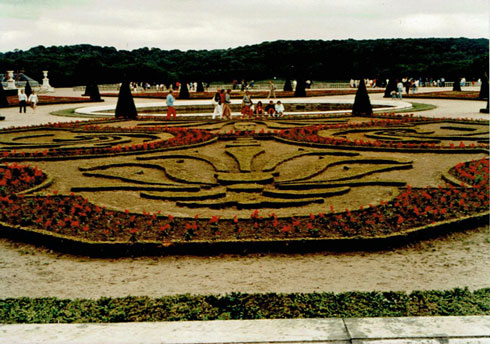
Our final stop was the palace of Versailles. I have no memory of the actual building, but its gardens, consisting of fountains and lawns and meticulously sculpted hedges, were magnificent. In the latter part of the 18th century Versailles was home to Marie Antoinette. When I was a kid I wished I had a babysitter like Marie instead of Grandma Pearl. Grandma Pearl complained about me eating Oreos within three hours of dinner; Marie would let me eat cake. The choice was obvious. France, with an enthusiasm for removing body parts that bordered on psychotic, had her beheaded (Marie Antoinette, not Grandma Pearl) in 1793. She ceased being Queen soon afterward.
And thus, our five weeks spent gallivanting around the continent amidst the hoi polloi came to an end. We saw what we were supposed to, and then some. It was time to begin the next phase of my life.
***
From Paris we flew into New York’s John F. Kennedy Airport. Regan’s father picked us up and took us to their home, where my Ford Pinto had been parked the past month. I took the Long Island Expressway to the Brooklyn-Queens Expressway to the George Washington Bridge into New Jersey. I arrived at 16 Carol Drive. Home. No museums in our town. No towers. No ancient cathedrals. No palaces, though we had the Royal Cliffs Diner. And good pizza, which we washed down with New Coke.
That was me at 21. Decades later, I still don’t get a thrill from a Caravaggio. If you do, fantastic! Like what you like. But if you think his work belongs in our living room, we probably shouldn’t get married. Having your own taste doesn’t make you a contrarian. It just means you’ve figured out what moves you instead of accepting what you’re told should move you.
Not to knock Europe On $25 A Day, but a guidebook is only helpful up to a point. Guidebooks can make suggestions, but ultimately, you need to decide where you want to go. It’s your life.
***
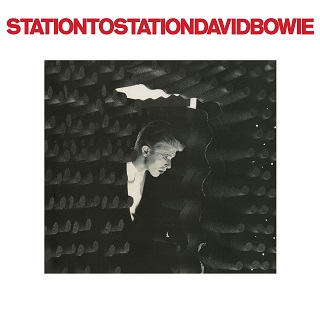
STATION TO STATION
In April 1975 David Bowie announced his retirement from rock & roll, calling it a “boring dead end.” Around the same time he told friends that witches were trying to steal his semen. One of these things turned out to be untrue. In the autumn of 1975, Bowie announced a world tour to support his upcoming album, Station By Station.
If you know one song from that album, it’s likely “Golden Years,” a funky, catchy number which Bowie admitted he wrote to chase a hit. Legend has it that before he put out his version, he offered the song to his fellow January 8th birthday celebrant, Elvis Presley. It was one of two songs he performed on the television program Soul Train, Bowie becoming the second white artist to appear on that show (Elton John performed on it a few months prior). Like Michelangelo’s David, “Golden Years” was art that the masses could appreciate. It became his second US top ten single and went top 40 in much of Europe. It would be his last song to make the US top 40 prior to 1983’s “Let’s Dance.”
The next single was “TVC15,” an uptempo bop about a television swallowing Iggy Pop’s girlfriend. Now’s a good time to mention Bowie was doing A LOT of cocaine then. You may think the bizarre subject matter is what kept it from the top 40, but this was 1976—one of the year’s biggest hits was about a man who when he visits a disco turns into a duck. Another was a song about muskrats in love who eat cheese and swing dance and get engaged. And then there was “Convoy,” about trucks driving over the speed limit. Clearly Americans were not discerning about lyrical content in 1976, but something about “TVC15” didn’t work for them. It was a blue canvas in a wax museum.
“Golden Years” and “TVC15” were two stops on what felt like Bowie taking the listener on a journey, a journey that begins with the song “Station To Station.” Over the course of its ten-plus minutes, Bowie takes us on a trip from his narrator’s emotional detachment to a strong desire to feel.
The journey/album ends with Bowie doing “Wild Is the Wind,” a hit in 1957 for Johnny Mathis. On paper, a Mathis cover on a Bowie album stands out like Jack Benny at an orgy, but Bowie owned it. Even Frank Sinatra spoke highly of Bowie’s rendition. As we debark, it’s clear that the weird and the accessible can co-exist.
The Station To Station album shot into the Top 5 in the UK and the US. Bowie wouldn’t attain that chart position in America again for another 37 years. The singer said that this album and its follow-up, 1977’s Low, were his favorites from his catalogue.
“Turn and face the strange” weren’t just words he sang on an earlier album. He turned, faced, and walked into it. His art pushed boundaries. He challenged expectations.
I arrived in Europe with expectations—to check off everything on the list of what I was supposed to see. Luckily, I found room to face the strange. I could embrace both “We Are the World” and a blue rectangle. The Louvre and Madame Tussauds. I could even embrace a pigeon’s artistic contribution to Bruce’s shirt—though I recommend not embracing Bruce himself until the paint dries. I didn’t have to choose. Bowie didn’t choose between commercial hits and avant-garde experiments—he did both. I didn’t have to give up who I was to become a sophisticated, cultured citizen of the world. Both could co-exist. As David Bowie said, “The truth is, of course, that there is no journey. We are arriving and departing all at the same time.”
If you scroll through a playlist of Britney Spears’s greatest hits, you’re not just looking at a list of popular songs. You’re tracing a remarkable path through modern pop music, one that is often defined by its distinct chapters. The journey begins with the now-iconic “…Baby One More Time,” a song that launched a career and set a new standard for late-90s pop. Tracks like this, along with “Oops!…I Did It Again” and “(You Drive Me) Crazy,” presented a specific, highly polished image: the approachable girl next door, navigating first loves and heartbreaks. Even in these early days, however, songs like “Lucky”—a surprisingly melancholic look at a famous girl who is crying behind her smile—hinted at the complex relationship with fame that would become a recurring theme in her work.
It wasn’t long before that polished image began to intentionally crack and evolve. The shift is palpable. You can hear it in the slinky, breathless production of “I’m a Slave 4 U,” a track that signaled a clear departure from her previous sound and a confident step into a more adult persona. This era wasn’t just about a new sound; it was about a new narrative. In songs like “Overprotected” and “Stronger,” the lyrics became declarations of independence, pushing back against outside control and expectations. It was a crucial pivot, one where the artist began using her music to comment on her own public journey, a theme she would revisit with even more focus later on.
As her career progressed into the mid-2000s, Spears became a central figure in the electronic and dance-pop wave that would dominate the decade. This is perhaps her most sonically adventurous period, producing some of pop’s most enduring anthems. The frantic, string-driven beat of “Toxic,” the demanding pulse of “Gimme More,” and the robotic sneer of “Womanizer” are all masterclasses in dance floor command. This period also saw the subject matter of her songs become its most self-referential. With “Piece Of Me,” she directly addressed the media frenzy surrounding her life, turning the camera back on the audience with a defiant and clever hook. It’s a bold move that transformed her from a subject of pop culture into one of its sharpest commentators.
Of course, the story isn’t all high-energy production and defiant statements. Woven throughout this catalogue are moments of striking vulnerability that offer a different kind of insight. The simple, piano-led melody of “Everytime” stands in stark contrast to the high-octane tracks that often surrounded it, revealing a quiet fragility. This emotional range is a key part of her artistry. Similarly, her collaborations show her ability to stand alongside fellow icons, from the dance-off with Madonna in “Me Against The Music” to her graceful return on the warm, inviting duet “Hold Me Closer” with Elton John, a track that feels less like a comeback and more like a welcome continuation.
Listening back, from the earnest pop of “Sometimes” to the commanding instruction of “Work Bitch,” what emerges is the sound of an artist continuously recalibrating. Her discography tells a story of growth, defiance, and resilience, all filtered through the lens of pop music. Each song is not just a hit, but a snapshot of a specific moment, capturing a young woman defining herself, a global star navigating immense pressure, and an artist creating a body of work that has profoundly shaped the sound and style of pop for more than two decades.
The year 2000 arrived with a collective sigh of relief. The much-hyped Y2K bug turned out to be a non-event, and the new millennium stretched out before us, feeling both futuristic and strangely familiar. Looking back at the music from that year, you can hear a similar dynamic at play. It wasn’t a time of radical genre fusion or crossover; instead, it felt like several distinct musical movements were all cresting at the exact same time, each one confident and fully-formed. It was a year where you could switch the radio station and feel like you were jumping between entirely different worlds—from the polished pop of Britney Spears to the raw energy of DMX.
On one hand, pop and R&B were operating at peak performance, dominating the charts with precision-engineered hits. This was the era of the blockbuster music video, and artists delivered. Madonna reinvented herself yet again with the electro-thump of “Music,” while Britney Spears’s “Oops!…I Did It Again” perfected the formula she had established just a year prior. At the same time, R&B was in a period of remarkable innovation. You had the staccato, futuristic production of Timbaland on Aaliyah’s “Try Again,” the iconic, conversational flow of Destiny’s Child on “Say My Name,” and the deep, simmering soul of D’Angelo’s “Untitled (How Does It Feel).” These weren’t just great songs; they were statements of intent from artists at the top of their game.
Meanwhile, rock music was pulling in several different directions at once. Pop-punk had fully broken through to the mainstream, and blink-182’s “All the Small Things” was its endlessly catchy, stadium-sized anthem. More established acts like Foo Fighters and Red Hot Chili Peppers were delivering some of their most memorable melodic rock with “Learn to Fly” and “Californication,” respectively. Yet, on the fringes, things were getting much stranger and more interesting. Radiohead completely abandoned guitar-rock expectations with the anxious, electronic pulse of “Idioteque,” while Queens of the Stone Age offered a taste of heavy, hypnotic desert rock with “Feel Good Hit Of The Summer.” There was no single, unified “sound of rock” in 2000; there were several.
Hip-hop was arguably the most creatively vibrant and commercially powerful force of the year. The genre’s expansion was on full display, from the confrontational wit of Eminem’s “The Real Slim Shady” to the pure, unbridled velocity of OutKast’s “B.O.B.” which still sounds like it was beamed in from the future. The clubs were fueled by the aggression of DMX’s “Party Up (Up in Here)” and M.O.P.’s “Ante Up,” while Jay-Z’s “Big Pimpin’” projected an image of untouchable cool. And of course, you can’t talk about 2000 without acknowledging the songs that were simply inescapable. The unabashedly goofy charm of Sisqó’s “Thong Song” and the perhaps baffling, universal appeal of “Who Let the Dogs Out” added a unique and memorable flavor to the year’s sonic identity.
Listening back to this collection of songs now, what’s most striking is how separate but equal everything feels. This was one of the last moments before the digital revolution would completely flatten the music landscape, encouraging artists to borrow from everywhere at once. The year 2000 wasn’t about blending; it was a snapshot of distinct scenes, each with its own definitive soundtrack. From the raw scream of Kelis on “Caught Out There” to the quiet contemplation of Moby’s “Porcelain,” it was a year of powerful, parallel streams, a final, confident roar from the 20th-century music industry before everything changed.
If you’ve ever found yourself on a dance floor, there’s a very high probability you’ve been moving to the work of Nile Rodgers. While his name might not be as instantly recognizable as the superstars he’s worked with, his sound is an undeniable part of modern music history. Looking at a playlist of his work is like taking a tour through the last five decades of pop, funk, and rock. He’s the common thread, the secret ingredient, and the architect behind countless hits, often armed with his signature 1960 Fender “Hitmaker” Stratocaster.
It all starts with Chic, the band he co-founded with the brilliant bassist Bernard Edwards. On tracks like “Good Times,” “Le Freak,” “I Want Your Love,” “Everybody Dance,” and the rest of the Chic songs on this list, Rodgers served as co-writer, guitarist, and co-producer. This partnership, known as The Chic Organization, became a powerhouse production unit. They took their signature blend of sophisticated funk, propulsive rhythms, and string-laden elegance and applied it to other artists. For Sister Sledge, they wrote, produced, and performed on “We Are Family,” “He’s the Greatest Dancer,” and “Lost In Music,” transforming the family group into global sensations. They did the same for Diana Ross, delivering her iconic hits “Upside Down” and “I’m Coming Out,” where Rodgers once again handled co-writing, guitar, and co-production duties.
As the 1980s dawned, Rodgers stepped into a new role as a solo super-producer, shaping the sound of the decade. He produced David Bowie’s blockbuster album Let’s Dance, playing his distinct, chiming guitar on the title track, “Modern Love,” and “China Girl.” While he didn’t write those songs, his production and arrangements are largely responsible for making them monumental hits. He did the same for Madonna, producing her album Like a Virgin. On tracks like the title song, “Material Girl,” “Dress You Up,” and “Angel,” Rodgers was the producer and a key guitarist, helping to craft the clean, sharp, and irresistibly danceable sound that defined her early career. He also brought his Midas touch to the world of New Wave, producing the hit single version of Duran Duran’s “The Reflex” and co-producing their smash, “Wild Boys.”
Beyond these marquee names, Rodgers’s discography reveals an incredible range. He was the producer who helped The B-52’s craft the polished and joyful sound of “Roam.” He produced the sleek, funk-rock of INXS’s “Original Sin” and the anthemic “Lay Your Hands On Me” for the Thompson Twins. His work with female vocalists continued to shine, from co-writing and co-producing the criminally underrated groove of Carly Simon’s “Why” to lending that same full-service treatment to Debbie Harry’s solo track “Backfired,” Grace Jones’ “I’m Not Perfect,” and Sheila & B. Devotion’s European disco classic, “Spacer.” On each of these, he was not just behind the board but was an active writer and musician.
Decades later, that same unmistakable guitar and rhythmic sensibility are as relevant as ever. His re-emergence into the mainstream wasn’t a comeback, but simply a reminder that he never left. He brought his magic to Daft Punk’s “Get Lucky,” which he co-wrote and on which he played that instantly recognizable guitar riff. More recently, he contributed his guitar playing and received a co-writing credit on Beyoncé’s “CUFF IT,” a track that feels like a direct descendant of the joyful, sophisticated funk he pioneered. From disco to new wave, and from 80s pop to 21st-century R&B, Nile Rodgers’s role has been consistent: he is the man who provides the foundation, the feel, and the funk that makes the world want to dance.
It’s hard to overstate how culturally dominant pop music was in 1984—or how much the year reshaped the landscape. Many of the songs on this playlist weren’t just hits; they were defining moments, launching or solidifying the careers of artists whose names still carry weight today. The sheer number of songs from 1984 that are still instantly recognizable points to a moment when creativity, commerce, and cultural change aligned. The presence of “Thriller”—Michael Jackson’s seventh single from the album of the same name—reminds us that the music business had never seen anything quite like this before. And yet, he wasn’t the only artist making history.
Prince’s “Purple Rain” marked not just a commercial breakthrough, but a creative one. It’s a song, an album, and a film—each enhancing the other’s mythology. Similarly, “Like a Virgin” signaled Madonna’s arrival as more than a pop star; she became a cultural force. Tina Turner, with “What’s Love Got to Do with It,” pulled off one of the most celebrated comebacks in music history. And Cyndi Lauper’s “Girls Just Want to Have Fun” brought an infectious blend of new wave and punky playfulness to the mainstream, reshaping ideas about femininity and pop performance.
Meanwhile, the rock world was hardly on pause. “Jump” became Van Halen’s biggest hit, thanks to its synth hook and anthemic chorus, while Bruce Springsteen’s “Dancing in the Dark” pushed his career into stadium territory. Across the Atlantic, U2’s “Pride (In the Name of Love)” began their transformation from college radio favorites to global headliners. The Replacements’ “I Will Dare,” from Let It Be, captured the heart of American indie rock—irreverent, emotionally raw, and just tuneful enough to hint at wider possibilities. And among the post-punk and alternative set, songs like “The Killing Moon” by Echo & the Bunnymen and “Heaven Knows I’m Miserable Now” by The Smiths gave moody introspection a lasting soundtrack.
What also stands out in 1984 is the range of genres that made a mainstream impact. Shannon’s “Let the Music Play” helped lay groundwork for freestyle, and Chaka Khan’s “I Feel for You” was a pivotal crossover moment, bringing together R&B, pop, and hip-hop. Run-D.M.C.’s “Rock Box” did something similar, blending rap and rock before it was fashionable. The Pointer Sisters’ “Automatic” was one of several hits that proved they could thrive in an electronic pop era without losing their vocal identity. Even novelty songs like “Ghostbusters” or the cheerful “Wake Me Up Before You Go-Go” helped shape the sound of the time.
Beyond chart success, 1984’s songs carried messages—sometimes playful, sometimes political. “Free Nelson Mandela” by The Special A.K.A. was a global anthem of protest. Depeche Mode’s “Blasphemous Rumours” examined faith and fate with a dark electronic edge. And “Somebody’s Watching Me,” a paranoid slice of synth-pop, foreshadowed a media culture on the verge of explosion. Whether on the dancefloor, in dorm rooms, or through the television set, 1984’s music didn’t just reflect its era—it helped define it.
Throughout the next however many months I’ll be counting down my 100 favorite albums, because why not. I’m up to number seventy-one.
New York City is full of woke, stuck up, superficial, opinionated, sarcastic, cooler-than-thou, smarter-than-thou, righter-than-thou coastal elites who are always in a rush to get somewhere, and yet I still had trouble finding my tribe there. You’d think it would be easy in a city of 8 million residents, exactly 55% of whom self-identify as queer, another 12.5 % I’VE identified as queer, 32% are queer-adjacent, and .5% should just fucking relocate. Like, yesterday.
Why is meeting like-minded people such a challenge for me? I know I’m not at the top of the gay man hierarchy, among the buff Adonisi whose bodies would’ve made Michelangelo throw in the chisel. Nor am I at the bottom, which is shared by former New York congressman George Santos and the late Roy Cohn, may he rot in hell. I know I shouldn’t speak ill of the dead, but I’m sure even Satan was like “Yuck. I gotta let this asshole in? He’ll bring down my property value!”
Surely there are others who, like me, exist between the two poles. Bendix, the Thai diner on Eighth Avenue, wasn’t Le Bernardin nor was it Domino’s Pizza. It was a perfectly fine place to eat where one could easily find something yummy on the menu. That’s who us inbetweeners are. We’re the Spicy Noodles of the LGBTQ+ buffet. And while part of me wants to be recognized, worshiped, exalted – to be in with the in crowd, to go where the in crowd goes, I’d gladly settle for a smidgen of companionship with those who also inhabit that unremarkable, yet presumably populated, territory between the Herculean ideal and the spectacularly flawed. I don’t need a ticker-tape parade of dancers and balloons and a float carrying the reunited cast of Absolutely Fabulous; just an understanding nod that says, “Yes, you. The one in the Olivia Newton-John concert t-shirt from 1982. We see you.” That’s not so easy to find in Manhattan, where I was just another New Yorker trying not to spontaneously combust when a tourist decides the entirety of the sidewalk is the perfect spot to unfurl a goddamn map the size of a small throw rug. Vamoose!
I don’t remember how I found it, but the biweekly storytelling workshop I attended in the early 2000s filled this void the way I fit in my Olivia Newton-John 1982 concert t-shirt, which is to say perfectly! Queer Stories for Boys was where gay men, most of whom were in their thirties and forties, shared real stories from their lives – some heartbreaking, some hilarious, some of which would be inappropriate for me to repeat here but I will anyway. I don’t think any of us “boys” considered ourselves kings of the gay hill, top of the gay heap, gay-number-ones. We were more an island of misfit toys, where those of us who don’t fit in fit in.
Every other Saturday, we’d meet at the LGBT Center in Greenwich Village. Fittingly, the room was pretty generic – not spectacular, but not the George Santos of rooms either. Its white ceiling and walls were clean, as was its simple tiled floor. We sat on metal folding chairs showing years of wear by windows overlooking bustling city streets. Outside, the usual New York soundtrack played on: sirens wailing, impatient drivers leaning on their horns, jackhammers hammering, drummers drumming, pipers piping, pigeons engaged in knife fights. Inside, a dozen or so spicy noodles repeated “I remember” to see where it led. With open minds and no expectations, we let our memories surface freely.
One person’s “I remember” may inspire another’s. Robin may say “I remember I remember I remember being a kid trick or treating and hoping that instead of Razzles or candy corn all the neighbors would give me sunflower seeds” which would lead to Harry saying “I remember I had a summer job at Camp Johnny Appleseed as an archery instructor, which kept me on my toes” which would lead to me saying “I remember the first time someone sucked my toes,” at which time I observed Gregg laughing and squirming in his seat, which is ASL for “Been there, done that.” I’m not going to relate that story to you, reader. Sorry. Nope. Not gonna happen. You best move on.
La la la.
Fine. You win. I can’t take any more of your badgering. At this point I honestly can’t recall the first time or the last time some big piggy took my little piggies into their mouth. There may have been only one time. Who was it? When was it? Were they intentionally looking for some foot-based intimacy? Or did I, in a wacky Lucille Ball moment of supreme clumsiness, accidentally, while clambering into bed, plunge my big toe into a mouth that was as open as Macaulay Culkin’s on the Home Alone poster? Was it with Já, with whom I had a brief vacationship in Provincetown in my early thirties? He did seem overly enthusiastic about shrimp. (Note to self: delete that corny joke on the next draft.) Or perhaps it was that hottie from the record store, who, while we sat on my bed watching Mary Poppins (I know how to set the mood!), kept inexplicably yelling “WHORE!” at the screen every time the character of Mary Poppins appeared. No clue why. It’s not like they showed Bert sweeping her chimney. (Note to self: delete that corny joke on the next draft.) Now that I think about it, a guy I dated a few years later did the same thing. Clearly, I have a type. And apparently, it’s men whose pasts include Edwardian nanny-induced trauma that has given them emotional baggage large enough to hold a hat stand, a large floor mirror and a floor lamp.
In any case, I’m trusting you with this deeply personal, embarrassing, and somewhat murky memory. I’d be mortified if anyone I know – friends, family, co-workers, those who work in the shoe department at Bloomingdale’s – finds out. So after reading this, please do me a little favor and set your laptop on fire. And the laptops of everyone you know. And everyone you don’t. Spit spot. I keep my lurid tales of debauchery buried under a Snuggie of shame, shared with nobody except a roomful of passing acquaintances in Greenwich Village.
So, who were these queerbos with whom I confided my private tales of podophilia?
There was Doug, a screenwriter and the facilitator of the storytelling workshop, who, like me, shared a deep appreciation for Rufus Wainwright, though while I was an I-have-the-CDs-and-I-saw-him-in-concert-downtown-and-said-hello-to-him-when-I-saw-him-on-Eighth-Avenue-for-he-lived-in-the-neighborhood kind of fan, Doug was to Rufus what Deadheads were to Jerry Garcia, seeing his concerts in venues across these United States. That’s passion. That’s dedication. That’s not happening with my lazy ass. My motto is “If I can’t walk there, I ain’t going there.” My motto could us some work.
At QSFB, Doug told us of the plays he scripted as a child, stories of dinosaurs and monsters and mutants from outer space. In hindsight, he viewed his creations as metaphors for his feeling “different,” and telling his stories became a way to embrace that identity and liberate himself from societal expectations and any lingering internalized homophobia. Omnes nos ab exterior spatio mutants, which is Latin for “We are all mutants from outer space.” My mottos are getting better.
A couple of years after I joined QSFB, Doug, who was in his early fifties, started bringing his new boyfriend to our meetings — a tall 19-year-old dancer with curly blond hair who would unironically share stories about tall 19-year-old curly blond dancer things, like hanging out with his classmates watching Teletubbies. Doug would roll his eyes and let out an Oscar-worthy sighsuggesting a suffering more profound than what Meryl Streep’s character in Sophie’s Choice underwent. “See what I have to put up with?” We all nodded in commiseration, and passed around a collection plate to help Doug pay for the years of therapy he’ll undoubtedly need to recover from this trauma. That’s my New York way of saying “Get over yourself, Doug!” Famous victims in history: Julius Caesar, knifed by dozens of Roman senators; Aeschylus of Eleusis, killed by a tortoise that fell from the sky (look it up—it’s a crazy story); Doug, crucified daily by mentions of Tinky Winky from a tormentor who possessed rock hard buttocks.
That’s not to suggest I thought little of Doug. Quite the contrary. He was the group member with whom I grew closest, and the one with whom I grabbed lunch at Bendix a couple of days after the 9/11 attacks on our city. Saying I was a wreck is like saying Brad Pitt is nice-looking. No, he’s GOURG, and I was a MESS. Each news report was a fresh assault, and I’d spent the better part of the week sitting on my bed crying. Sitting with Doug I attempted to articulate the enormity of what happened. “I just can’t wrap my head around this much hate! The loss! The absolute, unadulterated evil. How does one even process it?” Doug nodded, adding “What really disturbs me and pushes me over the edge is Bush’s pronunciation of ‘nuclear.’ ‘New-cue-lar.’ This is our leader?? We’re so screwed.” Looking back, I think Doug, like the rest of us, grappled with the collapse of civilization and couldn’t make sense of it. However, a misplaced vowel was an offense he felt more equipped to tackle.
***
Brad wore eyeglasses with lenses so thick even coke bottles were like “whoa.” He was legally blind, and his stories from the land of the visually impaired elicited from me reactions that were a mix of “OMG, I don’t know how you persevere” and “I may end up in hell with Satan and Roy Cohn for saying this, but your horror stories are friggin’ hilarious!” He recounted the time he went to the dimly lit bar Barracuda on 21st Street in the Chelsea gayborhood. There Brad spotted a guy, and this guy was looking at him. Every time Brad peeked, the guy was staring right back. A smile from Brad elicited a reciprocal smile – the universal language of “maybe.” Buoyed by this silent encouragement, Brad made his move. He started walking over. Meanwhile, the other man, equally bold, was walking towards him! Destiny! It was a beautiful, silent ballet of burgeoning attraction. They’re getting closer… closer… and BAM! Brad walked face-first into a mirror. It’s a classic love story: boy meets boy, boy is actually boy’s own reflection, boy gets a slight concussion. Romance is tricky, y’all.
***
Robin was slender and wore his hair in a ponytail—though his look was not of the Steven Seagal quiet man with mysterious past assassin variety. He looked like he should be living on a commune where the primary currency was positive affirmations, teaching yoga and eating tree bark, but somehow was here in Manhattan, perhaps as part of an exchange program. Somewhere in upstate New York at a vegan spiritual retreat was some poor, chain-smoking cynic from the East Village engaged in a silent meditation, asking his version of god “da fuck am I doing here?” In actuality, Robin worked as a writing professor at NYU. And I’m guessing he was great at it, as I was always engrossed in his stories of his world travels, his revelations from talking to himself while walking (side note: if you see people walking around Manhattan talking to themselves, they’re not mentally ill or unhoused; they’re NYU professors. Mentally ill, unhoused NYU professors), and poignant musings on his mother’s hidden history (quiet woman, mysterious past). I was genuinely thrown for a loop when he asked me on a date, as he didn’t strike me as one who would call Mary Poppins a whore. He was intelligent and thoughtful—a far cry from my usual partners, so I rebuffed him. Still, I did look forward to his perfectly delivered anecdotes on just about anything. His range was much, much wider than Steven Seagal’s.
***
Ronnie was an 80-something British expat who loved to share stories of his travels throughout Southeast Asia and the young men there who, according to Ronnie, were OBSESSED with him. Each anecdote would commence with a pronouncement of such startling improbability, a jaw-dropping premise concerning his irresistible allure, followed by a super dramatic “Well, I” and a long pause, as if he was as shocked by his story as we were. Actually, not a pause. The story ended with a cliffhanger, and we never found out who shot J.R. “I once found myself being serenaded by a trio of love-struck boys in a Bangkok nightclub,” he’d begin, his eyes twinkling. “Naturally, I selected one to accompany me back to my hotel room. This, regrettably, sparked some jealousy amongst the others. A scuffle broke out, and before you knew it, a knife was produced. Well, I…” And scene!
***
Nick was a longtime group member who’d mysteriously vanished before I joined and then reappeared with the story that he’d been hospitalized after hearing Spanish-speaking birds instructing him to kill. “Mata! Mata!” they’d chirp. Now medicated and serene, he was warmly welcomed back and enthusiastic to share, sprinkling nearly every story he told with references to the Greek Orthodox Church. He was genuinely kind, soft-spoken and eager to connect. One meeting, he shared with quiet excitement that his doctor had cleared him to stop his medication. It was the last time any of us saw Nick.
***
There was that high school student who attended twice. His contribution to the “I remember” segment was “I remember one time I found a quarter in the hallway at school, but then I saw it was Canadian.” There was a pause. We waited. Nothing further was forthcoming. Not even a “Well, I….” I give this kid props. When I was his age I wouldn’t have sought out a group of older gay men and shared that. Of course, when I was his age, I wasn’t yet gay, as evidenced by my crush on Olivia Newton-John. This kid knew who he was, and didn’t feel pressure to embellish his—calling it a story doesn’t seem fair to other stories. His unvarnished statement of fact.
While I admired this kid’s pluck, Doug’s puss was channeling Roger Ebert sitting through the 2001 cinematic non-classic that was Crocodile Dundee In Los Angeles. (From Ebert’s review: “I’ve seen audits that were more thrilling.”) Maybe it was his lifelong dedication to the craft of storytelling that caused Doug’s reaction, or maybe he looked at that kid and saw his own awkward not-fitting-in past, and his brain was just like, “Nuh uh. This is not the show Friends. I’m not here for you.” I wanted to say “Doug, find some compassion. Plus, if you treat this kid to a few dance lessons, in three or four years he could be the next boyfriend you complain about.”
***
Then there was George. A truck driver by trade, George was friendly, unpretentious, and often funny in a way that felt entirely unintentional. I wouldn’t describe him as “straight-acting,” as that implies internalized homophobia, feeling a need to conform to heteronormative expectations, and a lousy kisser. HOWEVER, George didn’t dress like a homo; he didn’t live in a gayborhood; he almost certainly didn’t drink cocktails that came with tiny umbrellas. Possibly the straightest thing about George is he was married to a woman. I know there are many gay men who marry women—I’m not going to get into the history of Liza Minnelli’s husbands right now, but in the case of George, I truly believe on his wedding day he was heterosexual, just as I was in my years worshipping Olivia Newton-John.
He shared his coming out story with us. He was sitting across from his wife at the kitchen table, both of them reading the newspaper over breakfast. She read aloud some innocuous, possibly even supportive, tidbit about gay people. George looked up, smiled, and said, “I’m gay,” and then “Pass the OJ, would you?” George’s wife didn’t react to that news by setting his clothes on fire like my favorite of Charlie’s Angels from my heterosexual days—Kate Jackson (the smart one)—did in the 1982 movie Making Love (from Roger Ebert’s review: “People have described the movie to me in one sentence as ‘Kate Jackson finds out her husband is homosexual,’ and they haven’t left out much.”), which until George’s story was my only reference point for wifely reactions to gay husbands. But there was no arson at George’s home. He and his wife just… kept reading. Kept eating. Kept sipping their OJ. Kept on being Mr. and Mrs. It’s a classic love story: boy meets girl. Boy and girl wed. Boy tells girl he’s gay. Girl passes the OJ and keeps reading the paper.
Another story George told involved him becoming obsessed with a song he heard on his truck radio, a tune that burrowed into his brain like RFK Jr’s worms (look it up—it’s a crazy story) and haunted him for days on end. He needed to own a copy, but the DJ failed to identify it. George would hum the melody for friends to zero recognition. Then one day, in the grocery store, the song came on over the sound system. George, as excited as a contestant who heard “Come on down!” on The Price Is Right, ran up to the nearest person in the detergent aisle, got in her face and yelled “What is this???” Confused and frightened, the woman stammered “Downy Fabric Softener.” “No, the song playing!!!” The reply: “‘Ray of Light’ by Madonna.”
Now, this is where George’s narrative collided with my understanding of basic reality. “Ray of Light?” I’m using the word “literally” correctly when I say literally everyone on Planet Earth, and possibly several adjacent dimensions, knew that song in 1998. Young, old, gay, straight, bourgeoisie, rebel, house pet, sentient dust mite, Teletubbies—all were humming it. Madonna was basically empress of the known universe then. We’re talking 16 million Ray Of Light albums sold. The “Ray Of Light” single went top ten in the U.S., the U.K., Italy, Spain, Canada, Australia, Greece, Hungary, Finland, New Zealand, Iceland, and Scotland (which is part of the U.K., but has its own charts. Go figure.). It even went to #1 in Croatia, which is literally the only thing I know about Croatia.
The image of George, mid-bite of English muffin, casually informing his wife he was gay, only for both to resume the quiet rustle of newspaper pages? I’m on board. I’ll file that under “stranger things have happened at breakfast.” But a gay man, in the late nineties, not knowing Madonna’s “Ray of Light?” That’s not just improbable; it’s a statistical impossibility, like being killed by a falling tortoise. Yet it was precisely tales like this – spectacularly suspect if from someone else yet oddly believable coming from one of our group – that made our QSFB meetings utterly unmissable.
***
I used to think “I live in Chelsea, the queerest of the queer of Manhattan’s gayborhoods, where the Pride parade is just another day on Eighth Avenue. My people are HERE!” All I had to do was walk out my door and I’d have my own guy versions of Charlotte, Samantha, and Miranda (Charlie, Sam, and Miroslav) to brunch with. To which the universe replied “Sorry Charlie…and Sam and Miroslav.” It turned out that geographical proximity to other ‘mosexuals did not, in fact, magically cure one’s inability to initiate conversation. Lots of fairies but no magical pixie dust. (Insert cocaine joke here.)
As Liza with a “z” commanded (back me up on this, Chelsea boys), you’ve got to ring them bells. For those of you afflicted with what my dermatologist refers to as the 3D Complex—Definitive Diva Deficiency (my dermatologist is as gay as the day is long), an explanation: in the song “Ring Them Bells,” Liza with a “z” tells the truly terrific, absolutely true story of a New Yawker named Shirley Devore, who, in a quest to haul her home a hus’, travelled to various places across the globe, as sitting in her apartment expecting a suitor to find her was…I don’t want to say dumb. Let’s go with stupid. She had to ring them bells. I had to ring them bells. And while Shirley went as far as Yugoslavia, I only needed to walk three blocks to 13th Street, the intersection of Liza, my loneliness, and my laziness.
In any given room I feel like the Creature from the Black Lagoon at a pool party. In the QSFB meeting room the plot twist wasn’t that I stopped being a swamp monster; it was that I’d finally found my swamp, full of weirdos with sharp claws, webbed hands, and iridescent, full-body fish scales. It may as well have been the Met Gala. If I may drop some very very deep knowledge for you to stick on your Pinterest vision board, it’s this: in a room full of monsters, you don’t have to pretend you’re not one. MIC DROP! Let me repeat that. In a room…oh, you can re-read it. I’ll wait.
La la la.
To just say your crazy out loud and have it met not with silence but with a nod is so powerful I’m gon’ call it Constantine the Great. (Constantine, by the way? Not a looker. He was the Creature of the Black Lagoon of fourth century Rome, but he made his mark.) And hearing someone else’s equally strange story was like gently unfastening that invisible yet ultimately isolating Snuggie of shame so many of us have been bundled in, smelling faintly of old regrets and takeout.
***
Light salmon. That’s the color I decided to paint my co-op’s walls, which from the moment I moved in 13 years earlier were jailhouse grey, my least favorite of the 50 shades. A fresh vibrant color would cheerify my 200 square foot abode. Sadly, with only weekends free, for one Saturday I was forced to trade my folding chair at QSFB for a paint roller, which led to my greatest, unrealized billion-dollar business idea: an interior decorating business for the Rapture-ready crowd, whose slogan would be “Jesus is coming. Repaint! Repaint!” He wouldn’t come all that way for beige. But before I could file the LLC, I got THE CALL. A Warner Music exec asked what it would take for me to move to Los Angeles to run their Licensing department.
My immediate thought: LA is a garbage city populated by stuck up, superficial, opinionated, sarcastic coastal elites who think they’re cooler-than-thou, smarter-than-thou, and righter-than-thou. Not my kind of people. And then, a lyric from my former neighbor Rufus Wainwright: “Life is the longest death in California.”
So, in an attempt to derail my career and get off the phone, I spat out a number I was certain would cause him to laugh like Vincent Price at the end of “Thriller” and hang up without so much as a “goodbye” or “thank you” or “enjoy your shitty weather”: I demanded a salary that was 80% higher than my current one. Then, because my mind was temporarily taken over by un hombre con cojones muy grande, I added, “And a car allowance.”
He said yes.
So, guess who was suddenly an LA-bound, stuck up, superficial, opinionated, sarcastic, cooler-than-thou coastal elite with a company-funded Audi convertible? I was happy with my new salary and proud of my negotiation skills, but at the same time I was sad about leaving New York and bummed that the workshop was over for me. My last four weekends in the city were no longer about community and sharing stories with my fellow freaks; they were about cardboard boxes and packing tape and selling old International Male catalogues on eBay. One man’s junk showing another man’s junk is yet another man’s treasure trails treasure.
Doug treated my departure as a personal betrayal. Think Julius Caesar recognizing Brutus as one of his assassins, or the Captain when Tennille served him with divorce papers. (Anybody else still shook about that? Love will keep us together? Whatever.) I went to say hello and goodbye to the group one weeknight, when a member was performing in a music recital. I sat right behind Doug, eager to say hello and catch up on the mirth and merriment I missed in May. He turned around and fired off a “Hihowareyougood,” and before the “d” even landed his back was to me and he was talking to his companion. I’m the Captain now. We never spoke again.
Writing this essay, some of the details were fuzzy. My brain, which is mostly full of Captain & Tennille trivia and anxiety, couldn’t remember, couldn’t remember, couldn’t remember things like if the group met weekly or monthly, so I did what any 21st century amnesiac does: I turned to the Google. I typed in “Queer Stories for Boys” and Doug’s name. I discovered he had a Wikipedia page, on account he wrote and directed a horror film in 1983. Wow. Our very own director of cinematic monsters, immortalized. The page mentioned our workshop. It also informed me that Doug had died in 2022.
When the pain from that punch to the gut subsided a tad, I looked up Robin. And there it was, an online memorial. He died last September. And on that page, someone had posted something that essentially was the raison d’etre of Queer Stories for Boys, why we all kept showing up in that room every other Saturday, even when the weather outside was beautiful: “Do you have a magic spell to return someone to life?” she asked. “No.” said the witch. “But, why don’t you tell me about them?” “Will that bring him back?” “For us. For a little while. Stories are a different kind of magic.” -Anonymous
And then, a quote from Margaret Atwood that said everything else: “In the end, we’ll all become stories.”
***
When you’re lonely in a big city, you think you’re looking for your “forever people,” the ones who will sit on your metaphorical couch—because who has a real couch in a 200-square-foot Manhattan apartment?—for the next forty years. The truth is, most people we encounter don’t become permanent fixtures in our lives. In the grand scheme of things they’re flashes. Some are just sparks, but if you’re lucky, some are golden rays of light that burst in and, for a too-short-but-you-wouldn’t-trade-it-for-the-world time, brighten your existence and make everything brilliant.
That was QSFB.
And I’ve felt those rays of light elsewhere: at my Toastmasters clubs, in my writers group, in improv classes, at office jobs, and on that on that one vacation with the guy whose enthusiasm for my feet was both unexpected and, cards-on-the-table, a little flattering. The goal, I’ve learned, isn’t to try and bottle the light as if it’s perfume, but to be awake and aware enough to see it and feel its warmth. The rays may not stay, but the stories do. The stories are the souvenirs, the trinkets, the snow globes I shake now and then as proof that on more occasions than I realize, my weird, lonely world was dazzlingly bright.
Naturally, this insight led me to do what any modern gay man of a certain age and too much time on his hands does when experiencing an Aha! moment of such profundity and clarity: I developed a detailed academic thesis connecting my life to Madonna’s Ray Of Light album. The evidence, I submit, overwhelmingly demonstrates that she and I are two peas of a podcast. Behold, the Queer Stories for Boys experience, as foretold by Her Madgesty:
In the song “Ray of Light,” Madonna sings of someone who “got herself a little piece of heaven.” For us it was our meeting room at New York’s LGBT Center, though calling it heaven might be overselling it. I can’t believe people would live so righteously, behave so saintly, and love their asshole neighbors while part of this mortal coil only to arrive at a place with uncomfortable metal chairs and no danish. Still, it was our free and happy place, away from a world that often isn’t kind to people or amphibious sea creatures like us.
In the album’s opening song, “Drowned World/Substitute for Love,” Madonna sings of how memories resurface and shift with time. Trés QSFB! She takes accountability for her choices, her fame, and the adoration she once craved, only to discover that what really mattered was human connection. That very discovery by me is what made me give up fame and mass adoration before they were unwillingly foisted upon me like QR code menus at every other goddamn restaurant in L.A. I guess I succeeded where Madonna failed. She’s so jealous of me. Stop trying to be me, Madonna!
“Frozen” asks us to global warm our icy cold hearts and allow for vulnerability and openness, letting go of regret, revenge, retaliation and radishes. (I added that last one. I loathe radishes.) Here’s some trivia for your next cocktail party: Like disposable vapes, hunting trophies, and the display of tobacco products, “Frozen” was illegal in Belgium, banned from airplay after a plagiarism claim in 2005. The ban was lifted in 2014. I guess you can say the Belgians waffled. (Note to self: don’t delete that joke. It’s comedy gold.)
While most hear “The Power of Good-Bye” as being about a romance gone kaput, its core idea — that goodbyes can be painful yet necessary — makes it apparent that Madonna is really singing about my leaving New York and my departure from the workshop. Stop obsessing over me and get a life, Madonna!
Both “Sky Fits Heaven” and “Nothing Really Matters” speak to the big, scary journey inward —choosing personal paths, trying to duct tape over old wounds, and attempting to “live in the present,” which, frankly, could stand to improve its Uber rating.
“Little Star” includes the line “Never forget who you are, Little Star,” a cosmic Post-It note that reminds me that even when my job changes, my home city changes, and my dogs are silently judging me, my core weirdo, with his anxieties and quirky traditions and Captain and Tennille trivia, is still there, shining.
***
I used to think belonging meant being welcomed everywhere with open arms, but I’ve learned that it’s not a choice between belonging or not belonging. Some of us belong with those who don’t belong, which means we do belong, and those others who don’t belong also belong, which means belonging is belonging and not belonging is belonging. It’s a profound thought that calls for Excedrin.
Before attending the workshop I associated storytelling with tragic actors turning their pain into a one-man show at a black box theater on Manhattan’s Lower East Side, ideally taped for HBO, which would then launch them into a form of superstardom only recognized in New York. But a story doesn’t need an HBO special to matter. It just needs to be told. Stories can help us find validation. Stories strengthen bonds between people. Stories expose us to different cultures and perspectives. Of course, stories can also be weapons of mass boredom and make listeners want to jab pencils into their eardrums, like Alan’s ten-minute saga at Toastmasters about seeing Katy Perry at a county fair. Nobody cares, Alan! You’re in Los Angeles! We’ve all seen “Katy Perry” at “a county fair.” Come back when you find a Canadian quarter.
In that room on 13th Street, I learned to hold my quirks with less shame and more affection. Upon reflection, scratch what I wrote earlier about my adventure with digitophilic behavior. If Alan can take pride in and feel no embarrassment about his Katy Perry at a county fair story (and kudos to him, for if I saw Katy Perry at a county fair I’d take that story with me to the grave), then I shouldn’t feel at all uncomfortable sharing my toe-sucking chronicle. The laughter of recognition I heard the day I related that at QSFB demonstrated that stories don’t just reflect us back to ourselves; they let someone else see themselves in you. And the fact that the back cover of Madonna’s 1992 album Erotica is a photo of her with a foot in her mouth is proof positive she’s a Glenn stan. (Older folks, ask your younger dancer boyfriend what that means. I need to wrap this up.)
I’ve also become more adept at navigating loneliness. Not erasing it, but, to some extent, accepting it, and often finding joy in my alone time. These days, I’m not concerned with getting into the club where the A-gays go. I put on my headphones and dance my ass off at home to… what’s the name of that song again, George?
Every June, Pride Month invites us to honor the LGBTQ+ community—not just its triumphs and ongoing struggles, but its wildly varied voices. This playlist, drawn from over six decades of music, is less a neat collection than a vibrant mix of statements, emotions, and identities. From Sylvester’s ecstatic disco classic “You Make Me Feel (Mighty Real)” to Billie Eilish’s “LUNCH,” the selections aren’t organized by genre, time period, or even theme. That’s fitting. The LGBTQ+ experience is too broad and multifaceted to be summed up by any single sound.
Some tracks speak directly to queerness, like Lou Reed’s “Walk on the Wild Side,” which namechecks drag queens and trans women, or Bronski Beat’s spiritual descendants, the Scissor Sisters, with their cheeky, loving anthem “Take Your Mama.” Others, like “Rocket Man” or “Do You Really Want to Hurt Me,” resonated with queer audiences before the artists behind them publicly came out—or even if they never did. There’s a history of coded expression here, of lyrics that offered solace to those reading between the lines.
Then there are the songs that became anthems of empowerment by sheer force of feeling: Christina Aguilera’s “Beautiful” offered a lifeline to LGBTQ+ youth when it first aired on MTV, while Madonna’s “Vogue” gave a global spotlight to a ballroom culture that had long gone ignored by the mainstream. Judy Garland’s “Over the Rainbow” might seem quaint next to Chappell Roan’s “Good Luck, Babe!,” but both songs capture longing, whether for love, acceptance, or the audacity to want more.
What unites these artists isn’t a single identity but a shared defiance—sometimes quiet, sometimes flamboyant—against what’s expected. Whether it’s the punkish ache of Buzzcocks’ “Ever Fallen in Love (With Someone You Shouldn’t’ve)” or the glossy Pet Shop Boys cover of “Go West,” the throughline is the refusal to shrink. Pride, in this sense, isn’t about perfection or performance. It’s about visibility, honesty, and a community that keeps evolving, note by note.
So, while this playlist won’t tell a single story, that’s exactly the point. Pride has never been about uniformity. It’s about claiming your truth, however it sounds—and blasting it through the speakers so someone else knows they’re not alone.
By 1990, pop music was as fragmented as ever, with the charts reflecting a mix of dancefloor anthems, alternative breakthroughs, and genre-defying oddities. Hip-hop’s mainstream ascent was well underway, electronic music was taking shape in new and exciting forms, and rock music was shifting toward something grittier. The year’s defining hits weren’t just about big hooks—they were about movement, whether physical, emotional, or cultural.
Dance music thrived in 1990, blurring the lines between house, hip-hop, and pop. Madonna’s “Vogue” channeled the underground ballroom culture into a global phenomenon, while Deee-Lite’s “Groove Is in the Heart” mixed funk, rap, and psychedelic whimsy into a club classic. Elsewhere, Snap! (“The Power”) and Black Box (“Everybody Everybody”) brought European dance music into the mainstream, and 808 State’s “Pacific (707)” hinted at a future where electronic beats would dominate pop music. Even hip-hop joined the party, with M.C. Hammer’s “U Can’t Touch This” and Digital Underground’s “The Humpty Dance” bringing humor and flamboyance to the genre.
Meanwhile, alternative rock was carving out a larger space. Jane’s Addiction’s “Been Caught Stealing” and Faith No More’s “Epic” merged funk, metal, and punk into something unpredictable. The UK’s Madchester scene, fueled by dance rhythms and psychedelic guitars, produced The Stone Roses’ “Fools Gold,” Happy Mondays’ “Step On,” and Primal Scream’s “Loaded,” while The Charlatans’ “The Only One I Know” signaled Britpop’s coming rise. Across the Atlantic, Tom Petty’s “Free Fallin’” offered a more traditional take on rock, while Aerosmith’s “Janie’s Got a Gun” tackled dark subject matter with arena-sized drama.
Elsewhere, pop and R&B pushed forward with innovation. En Vogue’s “Hold On” showcased impeccable vocal group harmonies, Lisa Stansfield’s “All Around the World” delivered a fresh take on blue-eyed soul, and George Michael’s “Freedom ’90” turned self-reinvention into an art form. Janet Jackson’s “Escapade” and Prince’s “Thieves in the Temple” kept their respective streaks of forward-thinking pop hits alive. And then there was Sinéad O’Connor’s “Nothing Compares 2 U”—a Prince-penned ballad that, in her hands, became one of the most emotionally raw performances of the era.
Yet 1990 also had space for the delightfully weird. They Might Be Giants’ “Birdhouse in Your Soul” was an offbeat yet catchy rock song that felt beamed in from another world, while Pet Shop Boys’ “So Hard” continued their sophisticated synth-pop explorations. Biz Markie’s “Just a Friend” made earnest goofiness into a virtue, and DNA’s remix of Suzanne Vega’s “Tom’s Diner” pioneered a new wave of genre-hopping, blending folk with electronic beats. Even the global phenomenon of “Lambada” proved that music was becoming more borderless. Whether through innovation, reinvention, or sheer force of personality, 1990’s music remains as compelling as ever.
Looking back at 1986, what stands out isn’t just the quality of the music, but how effortlessly genres merged and boundaries dissolved. Run-D.M.C. and Aerosmith’s “Walk This Way” wasn’t just a collaboration – it was a statement about how rock and hip-hop could amplify each other’s strengths. Prince, at the height of his powers, stripped everything down to bare essentials with “Kiss,” proving his superstardom could take any form. Robert Palmer’s “Addicted to Love” became inescapable, powered by one of the era’s most iconic videos, while Peter Gabriel’s “Sledgehammer” merged art rock with soul and funk, accompanied by groundbreaking stop-motion animation.
The women of pop music wielded particular influence that year. Madonna continued pushing buttons with “Papa Don’t Preach,” tackling teenage pregnancy in a way that sparked national conversation. Whitney Houston’s “How Will I Know” showcased her extraordinary vocal range while proving dance-pop could be both sophisticated and irresistible. Janet Jackson asked “What Have You Done for Me Lately,” establishing herself as a force independent of her famous family. Cyndi Lauper’s “True Colors” transcended its moment, becoming an enduring anthem of self-acceptance that would be covered for decades to come.
The underground was rising to the surface, but keeping its edge. The Smiths’ “There Is A Light That Never Goes Out” brought literary depth to alternative rock, while New Order’s “Bizarre Love Triangle” helped blueprint the future of electronic dance music. The Pet Shop Boys’ “West End Girls” married street-smart observations with pristine synth-pop, and Public Image Ltd.’s “Rise” proved post-punk could evolve without losing its bite. Even The Cure, with “In Between Days,” found a way to make melancholy sound surprisingly radio-friendly.
Soul and R&B were experiencing their own renaissance. Anita Baker’s “Sweet Love” brought sophisticated quiet storm to the mainstream, while Cameo’s “Word Up!” demonstrated funk’s continuing vitality. Grace Jones’ “Slave to the Rhythm” showcased the artist’s commanding presence, and James Brown reminded everyone he was still the Godfather of Soul with “Living in America.” The year also saw George Michael step out of Wham!’s shadow with “A Different Corner,” proving he could hold his own as a solo artist.
The year proved fertile ground for both established and emerging voices. Bruce Springsteen’s “My Hometown” painted a portrait of a changing America, while Billy Bragg’s “Levi Stubbs’ Tears” showed how personal stories could carry political weight. Elvis Costello’s “I Want You” pushed the boundaries of what a love song could express, and R.E.M.’s “Fall on Me” managed to be both cryptic and urgently relevant. Meanwhile, LL Cool J’s “I Can’t Live Without My Radio” brought hip-hop closer to the mainstream while maintaining its street credibility. In retrospect, 1986 wasn’t just a great year for music – it was a moment when artists across the spectrum proved that innovation and accessibility weren’t mutually exclusive.